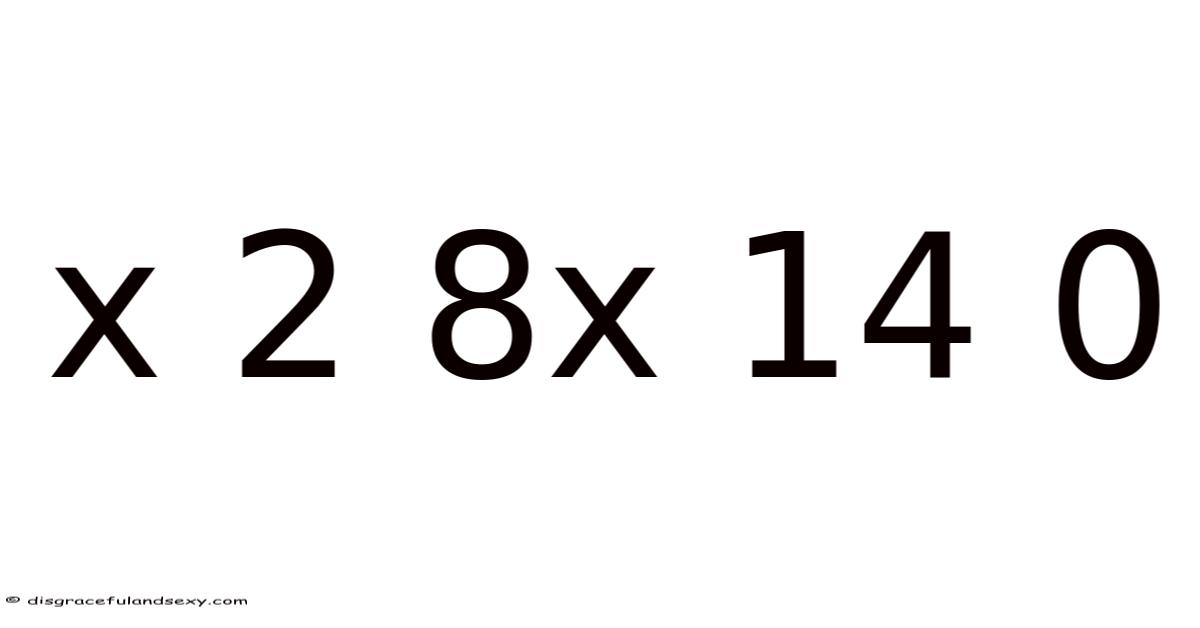
Decoding the Pattern: Exploring the Mathematical Sequence x 2 8x 14 0
This article breaks down the intriguing mathematical sequence represented by "x 2 8x 14 0". We will unravel the mystery behind this sequence, exploring its potential interpretations, solving for 'x', and discussing the broader mathematical concepts involved. Understanding this sequence requires a grasp of fundamental algebra and potentially, more advanced concepts depending on the intended interpretation. Let's begin our exploration!
Understanding the Notation: What Does "x 2 8x 14 0" Mean?
The notation "x 2 8x 14 0" strongly suggests a quadratic equation. In algebra, a quadratic equation is an equation of the form ax² + bx + c = 0, where 'a', 'b', and 'c' are constants, and 'x' is the variable we aim to solve for. In our case, it appears that the sequence represents this equation, with the spaces indicating the separation of terms Small thing, real impact..
x² + 2x + 8x + 14 = 0
This initial interpretation is crucial in understanding the steps to solve for 'x'. On the flip side, we must also consider the possibility of other interpretations, especially if the spaces were intended to represent a different mathematical operation or pattern And it works..
Solving the Quadratic Equation: Finding the Values of 'x'
Our primary focus will be on solving the quadratic equation derived from the sequence. There are several methods to accomplish this, including:
-
Factoring: This method involves finding two binomials that multiply to give the quadratic equation. Unfortunately, this equation isn't easily factored using simple integer values.
-
Quadratic Formula: This is a more general method that works for all quadratic equations, regardless of whether they are easily factorable. The quadratic formula is expressed as:
x = [-b ± √(b² - 4ac)] / 2a
Where 'a', 'b', and 'c' are the coefficients of the quadratic equation (ax² + bx + c = 0). In our case, after simplifying the equation, we have:
x² + 10x + 14 = 0
Therefore: a = 1, b = 10, and c = 14. Substituting these values into the quadratic formula, we get:
x = [-10 ± √(10² - 4 * 1 * 14)] / (2 * 1)
x = [-10 ± √(100 - 56)] / 2
x = [-10 ± √44] / 2
x = [-10 ± 2√11] / 2
x = -5 ± √11
This gives us two solutions for 'x':
- x ≈ -1.68
- x ≈ -8.32
-
Completing the Square: This method involves manipulating the equation to create a perfect square trinomial. While effective, it's often more time-consuming than the quadratic formula for equations that aren't easily factorable That's the whole idea..
Exploring Alternative Interpretations
While the quadratic equation interpretation is the most likely, it's essential to consider other possibilities inherent in the ambiguous nature of the original sequence "x 2 8x 14 0". These alternative interpretations might involve different mathematical operations or patterns. Let's explore a few:
-
A Sequence with Missing Operators: Perhaps the spaces represent missing operators like +, -, *, or /. This would lead to numerous possibilities, most of which would likely result in nonsensical equations or require additional information to solve. Here's a good example: it could be interpreted as x * 2 + 8 * x + 14 = 0, which essentially leads us back to the original quadratic equation.
-
A Recursive Sequence: Could this be a recursive sequence where each term is generated based on the previous term or terms? Without further data points, defining a recursive rule that fits this limited sequence would be purely speculative.
-
A Number System with an Unknown Base: This sequence could represent a number in a base other than 10. Still, given the presence of 'x', this interpretation seems unlikely unless 'x' represents a digit in this unknown base And that's really what it comes down to..
The Importance of Context and Clarity in Mathematical Notation
The ambiguity of the original sequence highlights the critical importance of precise and unambiguous notation in mathematics. Day to day, the placement of spaces, the inclusion of operators, and the careful definition of variables are all vital for preventing misinterpretations and ensuring clear communication of mathematical concepts. Without clear notation, multiple interpretations are possible, leading to different solutions and potentially incorrect conclusions.
Deeper Dive: Understanding Quadratic Equations
Quadratic equations are fundamental in algebra and have numerous applications in various fields, including:
-
Physics: Describing the trajectory of projectiles, calculating the area of shapes, and modeling oscillations It's one of those things that adds up..
-
Engineering: Designing structures, optimizing processes, and solving problems related to fluid dynamics The details matter here..
-
Economics: Modeling supply and demand, calculating profits and losses, and predicting economic trends.
-
Computer Science: Developing algorithms, solving optimization problems, and designing graphical user interfaces.
Understanding how to solve quadratic equations is a crucial skill for anyone studying mathematics or related fields. The quadratic formula, in particular, provides a powerful and universal method for finding solutions, even for equations that aren't easily factored Not complicated — just consistent..
Frequently Asked Questions (FAQ)
Q: Can a quadratic equation have only one solution?
A: Yes, a quadratic equation can have one real solution (a repeated root) when the discriminant (b² - 4ac) is equal to zero. In our case, the discriminant was positive, indicating two distinct real solutions.
Q: What if the coefficients of the equation were different?
A: If the coefficients (a, b, and c) were different, the solutions for 'x' would also be different. The quadratic formula would still be applicable, and the nature of the solutions (real or complex) would depend on the value of the discriminant Small thing, real impact..
Q: Are there other methods to solve quadratic equations besides factoring and the quadratic formula?
A: Yes, completing the square is another method. Graphical methods can also be used to find approximate solutions by plotting the quadratic function and finding the x-intercepts (where the graph crosses the x-axis).
Q: What are complex numbers and how do they relate to quadratic equations?
A: Complex numbers are numbers that contain both a real part and an imaginary part (involving the imaginary unit 'i', where i² = -1). Quadratic equations can have complex solutions if the discriminant (b² - 4ac) is negative. These complex solutions appear as conjugate pairs.
Conclusion
The seemingly simple sequence "x 2 8x 14 0" has led us on a journey exploring quadratic equations, their solutions, and the importance of clear mathematical notation. We have solved the equation under the most likely interpretation, discovering two real solutions for 'x'. On the flip side, we also highlighted the potential for alternative interpretations, emphasizing the need for precise communication in mathematics. Understanding quadratic equations and their solutions is a cornerstone of algebraic proficiency, with widespread applications across numerous fields. This exploration serves as a reminder of the depth and versatility even within seemingly simple mathematical expressions.
