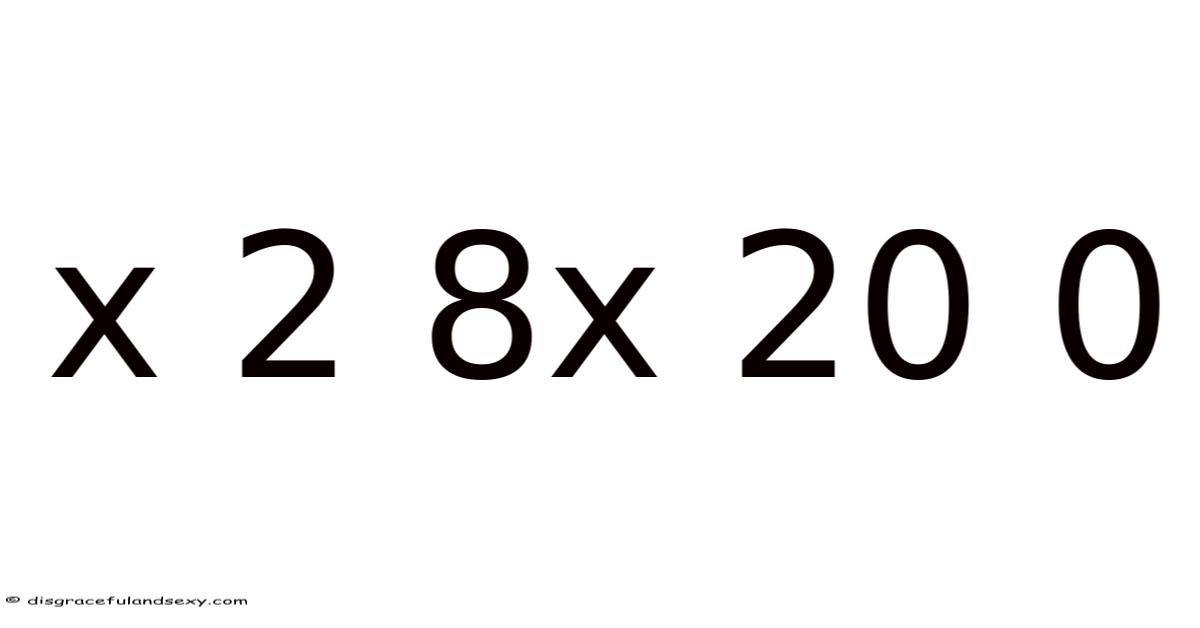
Decoding the Enigma: Understanding the Sequence X 2 8X 20 0
This article breaks down the intriguing numerical sequence "X 2 8X 20 0," exploring its potential interpretations, underlying patterns, and possible applications. In real terms, this exploration will cover different mathematical perspectives, examining possibilities ranging from simple arithmetic progressions to more complex coding systems. We will also consider the importance of the "X" variable and how its potential values impact the overall interpretation. While the sequence itself lacks immediate context, we can employ various analytical approaches to uncover its hidden meaning. Our goal is not only to decipher the sequence but also to demonstrate analytical thinking and problem-solving skills crucial in various fields, including mathematics, computer science, and cryptography.
Potential Interpretations: A Mathematical Exploration
The sequence "X 2 8X 20 0" presents a unique challenge. The presence of "X" immediately suggests a variable, introducing an element of uncertainty. To approach this, we can explore different scenarios based on potential values of X and the relationships between the numbers That's the whole idea..
1. Simple Arithmetic Progression:
A straightforward approach is to investigate whether the sequence follows a simple arithmetic progression (AP). Even so, this proves challenging due to the presence of "X.Which means " Let's assume "8X" represents a single number formed by the concatenation of 8 and X. Even then, establishing a consistent common difference between terms remains problematic Most people skip this — try not to. Practical, not theoretical..
Take this: if X = 1, the sequence becomes 1 2 81 20 0. Similarly, if X = 2, we get 2 2 82 20 0, which also lacks a clear arithmetic progression. This doesn't readily reveal an arithmetic pattern. This suggests that a simple AP is unlikely to be the solution.
2. Geometric Progression:
Geometric progression (GP) is another possibility. In a GP, the ratio between consecutive terms remains constant. Again, the presence of "X" makes it difficult to establish a consistent ratio. Think about it: let's examine this through examples. With X = 1, the sequence becomes 1 2 81 20 0. The ratios are 2, 40.Worth adding: 5, and approximately 0. On the flip side, 25, clearly not a geometric progression. The same holds true for different values of X.
3. Polynomial Relationships:
A more advanced approach is to explore if the sequence can be modeled using a polynomial function. This approach involves finding a polynomial equation that, when applied to the sequence's index (position), produces the corresponding term. Still, the presence of "X" complicates this. To simplify, let's temporarily ignore "X.On the flip side, " The sequence then becomes 2, 20, 0. Fitting a polynomial to such a limited set of data will lead to multiple solutions, making it less informative. This method necessitates more data points to provide a meaningful solution Worth knowing..
4. Coded Messages or Ciphers:
Given the unusual nature of the sequence and the presence of "X," a plausible interpretation could involve a coded message or cipher. The "X" could act as a placeholder or a key to reach the cipher. Various cryptographic methods might be considered:
- Substitution Cipher: "X" might represent a specific letter or number based on a substitution key. Further analysis would then require understanding the substitution scheme used.
- Polyalphabetic Cipher: The sequence might represent a fragment of a message encrypted using a polyalphabetic cipher like the Vigenère cipher, with "X" potentially related to the cipher key.
- Modular Arithmetic: Modular arithmetic (using modulo operations) is frequently used in cryptography. The sequence elements could be related through modulo operations, with "X" influencing the modulus.
5. Base Conversion:
It's worth considering if the sequence represents numbers in a different base. If "X" represents a digit in a non-decimal base, finding the base and converting the sequence to decimal representation might reveal a pattern. The use of "X" introduces complexity. Still, this analysis would require additional information or constraints to determine the base appropriately.
The Significance of "X": Unveiling the Unknown
The variable "X" acts as a crucial, yet elusive, element in this numerical puzzle. Its role is important in determining the underlying structure of the sequence. Without knowing the value or context of "X," all our mathematical approaches remain speculative.
Some disagree here. Fair enough Most people skip this — try not to..
- A Specific Number: A hidden numerical value that, when substituted, reveals a clear mathematical pattern or solves a cryptographic puzzle.
- A Variable Representing an Unknown Quantity: "X" could be linked to a larger mathematical equation or formula, acting as a variable to solve for.
- A Placeholder for an Operation: "X" might represent a specific mathematical operation that needs to be performed on the neighboring digits.
Further Investigation: Gathering Additional Information
To move beyond speculation, we need more information. The context in which this sequence appeared is critical. For example:
- Source of the Sequence: Where did this sequence originate? Knowing the source (a textbook problem, a code snippet, a puzzle, etc.) can offer significant clues about its meaning.
- Surrounding Data: Were there other sequences or numerical values presented alongside "X 2 8X 20 0"? Such context can help identify patterns and relationships.
- Specific Instructions or Constraints: Were there any associated instructions or constraints regarding the sequence? Take this case: is there a specific solution that's being sought?
Practical Applications and Real-World Examples
The techniques used to analyze "X 2 8X 20 0" have wide-ranging applications in diverse fields:
- Cryptography: Decoding the sequence involves principles similar to those used in breaking ciphers and securing communications.
- Data Analysis: Identifying patterns in sequences requires data analysis skills crucial in many scientific disciplines.
- Programming and Algorithm Design: Developing algorithms to find patterns or solve numerical puzzles demonstrates problem-solving abilities essential for programming.
- Mathematical Modeling: Developing polynomial or other functional models to represent numerical data is important for predicting and analyzing trends in science and engineering.
Conclusion: The Ongoing Quest for Meaning
The sequence "X 2 8X 20 0" remains a compelling enigma. While multiple mathematical approaches have been explored, the presence of the variable "X" makes definitive conclusions challenging without further context. The journey to unravel its meaning underscores the importance of analytical skills, critical thinking, and the iterative nature of problem-solving. The exploration provides a valuable lesson in tackling complex challenges by systematically exploring different possibilities and employing various analytical techniques. The ultimate decryption of this sequence hinges on obtaining additional information and defining the precise role of the unknown variable "X." Further investigation may reveal that this seemingly simple numerical puzzle harbors a far richer and more nuanced meaning than initially apparent. The process of seeking the solution, however, is as valuable as the solution itself. It demonstrates a critical methodology applicable far beyond this single numerical sequence.
