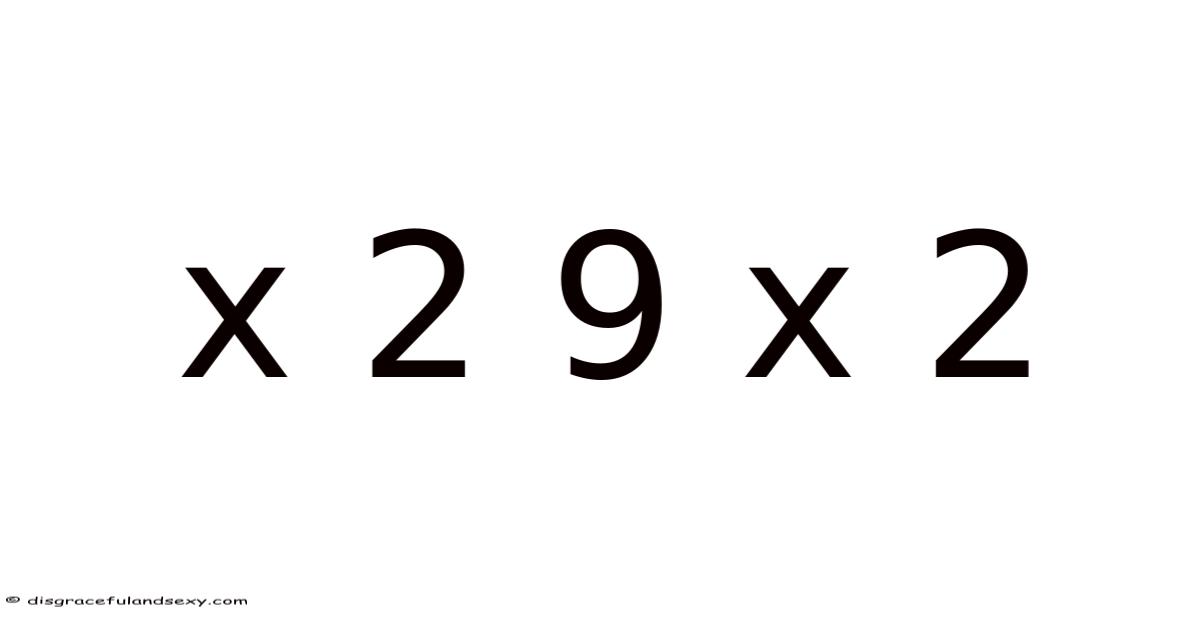
Decoding the Enigma: A Deep Dive into "x 2 9 x 2" and its Mathematical Implications
This article breaks down the seemingly simple yet surprisingly complex mathematical expression "x 2 9 x 2". Understanding this expression requires careful consideration of order of operations, algebraic manipulation, and potentially, the introduction of variables and functions. While the notation might appear ambiguous at first glance, we will explore its potential interpretations, analyze its solutions, and discuss the broader mathematical concepts it touches upon. This exploration will be suitable for those with a basic understanding of algebra, providing a stepping stone to more advanced mathematical concepts.
Short version: it depends. Long version — keep reading.
Understanding the Ambiguity: Order of Operations and Interpretation
The primary challenge with "x 2 9 x 2" lies in its ambiguous notation. The absence of explicit operators and brackets leads to multiple possible interpretations. This highlights the crucial importance of order of operations, often remembered by the acronym PEMDAS/BODMAS (Parentheses/Brackets, Exponents/Orders, Multiplication and Division, Addition and Subtraction).
The official docs gloss over this. That's a mistake.
Interpretation 1: Implicit Multiplication
This interpretation assumes the "x" represents multiplication. In this case, the expression could be interpreted as:
(x * 2) + 9 + (x * 2) = 4x + 9
This interpretation is arguably the most straightforward. Still, it assumes that the "x" acts as a multiplier before the addition operations are performed. Solving this would require additional information about the value of x.
(5 * 2) + 9 + (5 * 2) = 10 + 9 + 10 = 29
Interpretation 2: A Sequence of Operations with Implicit Multiplication
Another possible reading is to consider the expression as a sequence of operations with implicit multiplication. This could be written as:
x * 2 * 9 * x * 2 = 36x²
This interpretation groups all the multiplication operations together. Solving for x would depend on the context; if the expression equals a specific value, then we could solve for x using standard quadratic equation solving techniques. Which means the result is a quadratic equation. As an example, if 36x² = 144, then x² = 4, and x could be 2 or -2.
Interpretation 3: Concatenation (Less Likely)
In some programming contexts, the "x" might represent string concatenation. It would mean that "x" is not a variable but a string of characters. On the flip side, this interpretation is less likely in a purely mathematical context. The result would be a string, not a numerical value.
Expanding the Possibilities: Introducing Functions and Variables
We can further complicate – and enrich – the analysis by considering the possibility that "x 2 9 x 2" represents a function or involves more complex variables Simple, but easy to overlook..
Scenario A: Function Notation
It is possible that "x 2 9 x 2" represents a function, perhaps poorly notated. It might represent f(x) = 4x + 9, or g(x) = 36x², depending on the intended interpretation of the implicit multiplication. The notation is not standard mathematical function notation, however Practical, not theoretical..
Scenario B: Multi-variable Functions
We could even imagine that "x" represents a vector or matrix, and the "2" and "9" represent operations acting on these vectors or matrices. The result would depend heavily on the exact nature of these operations and the structure of "x" Simple as that..
Solving for x: Different Approaches and Considerations
Solving for x depends entirely on the interpretation of the expression.
-
For Interpretation 1 (4x + 9): We need a value for the expression to solve for x. To give you an idea, if 4x + 9 = 25, then 4x = 16, and x = 4.
-
For Interpretation 2 (36x²): We need the expression to equal a specific value. Take this: if 36x² = 36, then x² = 1, and x = ±1. If 36x² = 0, then x = 0. If 36x² = 144, as mentioned earlier, x = ±2.
The Importance of Clear Notation and Mathematical Precision
The ambiguity of "x 2 9 x 2" serves as a powerful reminder of the importance of clear and unambiguous mathematical notation. The lack of parentheses or explicitly stated operators creates multiple possible interpretations, each leading to a different result. This is why mathematicians are so meticulous about precision in their notation. A seemingly minor omission can lead to considerable confusion and misinterpretations.
Frequently Asked Questions (FAQ)
Q1: What is the single correct answer to "x 2 9 x 2"?
There is no single correct answer without further clarification. The expression is ambiguous, and its interpretation depends on the intended meaning of the notation.
Q2: Why is this expression confusing?
The confusion arises from the lack of clear operators between the elements. Without parentheses or explicit multiplication symbols, it is unclear which operations should be performed first Which is the point..
Q3: How can I avoid similar ambiguities in my own mathematical work?
Always use parentheses to group terms and clearly indicate the order of operations. Still, use explicit multiplication symbols (*) to prevent confusion. Be meticulous about your notation to prevent any misinterpretations Most people skip this — try not to. That alone is useful..
Q4: What mathematical concepts does this expression touch upon?
The expression highlights the importance of order of operations, algebraic manipulation, variable interpretation, function notation, and the potential for different interpretations based on context.
Conclusion: Beyond the Surface of a Simple Expression
The seemingly simple expression "x 2 9 x 2" presents a surprisingly deep exploration into the complexities of mathematical notation and interpretation. Consider this: ultimately, this exercise serves as a valuable lesson in the importance of clear communication and the potential pitfalls of ambiguous notation in mathematics. And this exercise has shown how a concise expression can lead to several valid mathematical interpretations, depending on the context and assumptions made. Plus, by analyzing this expression from different perspectives, we have not only solved for possible values of x but also gained a deeper appreciation for the subtleties of mathematical language and the importance of rigorous methodology. Day to day, its ambiguity illustrates the crucial role of clear and precise notation in avoiding confusion and ensuring accurate mathematical communication. Further exploration into more complex algebraic equations and functions will build on the fundamental concepts learned from this seemingly simple, yet enlightening problem.
The official docs gloss over this. That's a mistake.
