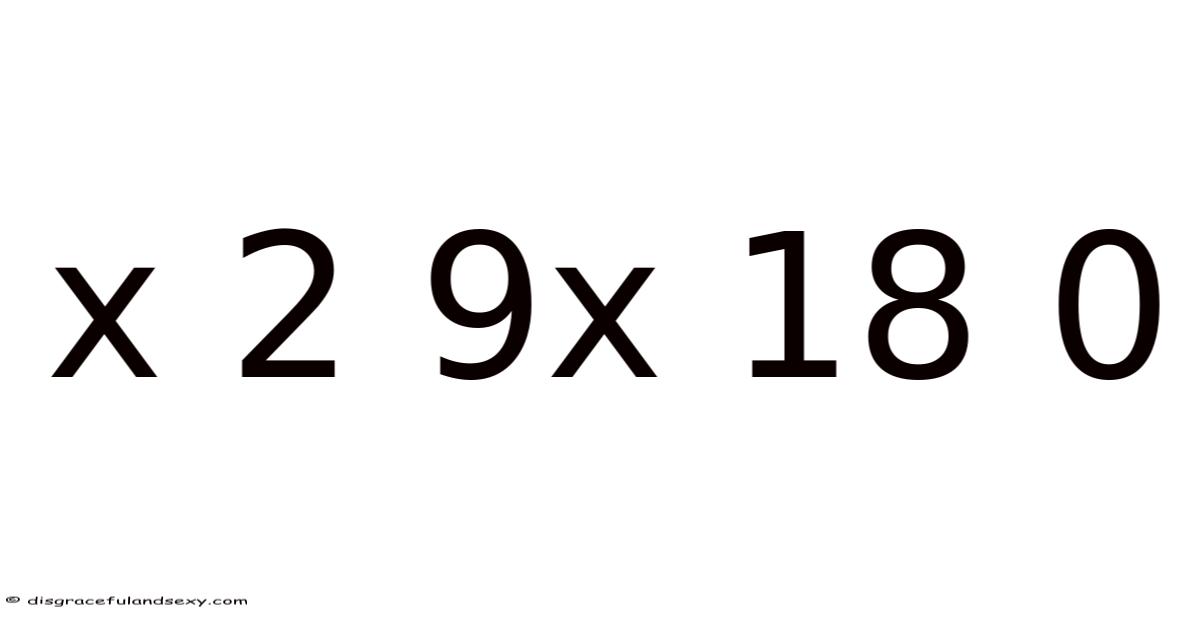
Decoding the Sequence: x 2 9x 18 0 – A Journey into Mathematical Patterns and Problem-Solving
This article breaks down the seemingly simple sequence "x 2 9x 18 0," exploring its potential meanings, underlying mathematical principles, and various approaches to solving it. Day to day, we'll move beyond a simple answer to understand the process of mathematical reasoning and the importance of considering multiple interpretations. This exploration will benefit students, math enthusiasts, and anyone interested in sharpening their problem-solving skills.
Understanding the Challenge
At first glance, "x 2 9x 18 0" looks like a rudimentary mathematical equation or perhaps a sequence of numbers. On the flip side, the ambiguity of "x" introduces complexity. The lack of explicit operators between some elements adds to the intrigue. Or something else entirely? Which means is "x" a variable representing an unknown number? In real terms, is this a quadratic equation? A geometric sequence? To effectively tackle this, we need to consider different possibilities Which is the point..
Approach 1: Treating it as a Quadratic Equation
The most straightforward interpretation is that the sequence represents a quadratic equation in the standard form: ax² + bx + c = 0. In this case, we could rewrite the sequence as:
9x² + 2x + 18 = 0
This assumes that "9x" signifies 9 multiplied by x squared, and that the spaces act as addition operators That's the whole idea..
To solve this quadratic equation, we can use various methods such as:
- Factoring: Unfortunately, this equation doesn't readily factor into simple integers.
- Quadratic Formula: This provides a reliable solution for any quadratic equation:
x = [-b ± √(b² - 4ac)] / 2a
Applying this formula with a = 9, b = 2, and c = 18 gives us:
x = [-2 ± √(2² - 4 * 9 * 18)] / (2 * 9)
x = [-2 ± √(-644)] / 18
Notice that the discriminant (b² - 4ac) is negative. This means the equation has no real solutions. The solutions would be complex numbers involving the imaginary unit 'i' (where i² = -1).
- Completing the Square: This method can also be used, but it leads to the same complex solutions as the quadratic formula.
So, if interpreted as a quadratic equation, the sequence has no real solutions for 'x'. This is a crucial insight; the seemingly simple problem leads to a more profound mathematical concept: the existence of complex numbers.
Approach 2: Exploring Other Mathematical Relationships
Let's move beyond the quadratic interpretation and explore if other mathematical relationships exist within the sequence.
-
Geometric Sequence: A geometric sequence has a constant ratio between consecutive terms. This doesn't immediately appear to be the case here, as the relationship between the terms isn't obvious.
-
Arithmetic Sequence: An arithmetic sequence has a constant difference between consecutive terms. Again, this doesn't directly apply That's the whole idea..
-
Polynomial Functions of Higher Degree: The sequence could potentially represent a polynomial equation of a higher degree (cubic, quartic, etc.). Even so, without more terms, determining the exact polynomial is impossible. We would need additional data points to establish a clear pattern That's the part that actually makes a difference. Worth knowing..
Approach 3: Considering Other Possibilities
Perhaps the sequence is not purely mathematical, but instead, a coded message or a puzzle with a different underlying logic Easy to understand, harder to ignore..
-
Hidden Patterns: The numbers themselves might hold clues. Notice the number 18, a multiple of 9. This could hint at a relationship between the numbers that isn't immediately apparent.
-
Base Conversion: Could the sequence represent numbers in a different base system (e.g., binary, ternary)? Converting to and from different bases could reveal a hidden pattern or meaning.
Expanding the Problem – Introducing Context
The difficulty in solving this problem highlights the importance of context. Where did this sequence come from? Now, what is the context or purpose behind it? Worth adding: in a real-world scenario, we'd likely have additional information about the problem’s origin. This additional context could significantly impact our approach and interpretation That's the part that actually makes a difference..
Honestly, this part trips people up more than it should.
For example:
- A programming problem: The sequence might represent a set of instructions or data points within a computer program.
- A cryptography puzzle: The sequence might be part of a cipher or code requiring decryption.
- A physics equation: The sequence might represent simplified parameters in a physical system.
The Importance of Multiple Interpretations
The “x 2 9x 18 0” sequence underscores the importance of approaching problems from multiple angles. There isn't a single, definitive answer without additional information. Think about it: the initial interpretation as a quadratic equation, while seemingly natural, only led to complex solutions. This opens the door for a broader exploration involving higher-order polynomials, coded messages, and different base systems That's the whole idea..
Problem-Solving Strategies
Solving mathematical problems often involves a combination of strategies:
- Pattern Recognition: Identifying patterns and relationships between numbers or terms is crucial.
- Trial and Error: Experimenting with different approaches and methods is often necessary.
- Deductive Reasoning: Using logical reasoning to eliminate possibilities and narrow down the solution space.
- Inductive Reasoning: Making generalizations based on observed patterns.
- Creative Thinking: Sometimes, the solution requires thinking outside the box and considering unconventional approaches.
FAQ
-
Q: Is there a single correct answer to this sequence? A: Without more information or context, there isn't a single, universally correct answer. The interpretations and solutions are dependent on the assumed context and mathematical framework.
-
Q: What is the purpose of this ambiguous problem? A: The ambiguity is intended to highlight the importance of critical thinking, problem-solving skills, and considering multiple perspectives when tackling a mathematical challenge. It emphasizes that the solution isn't always obvious and often requires a thorough examination of various possibilities Still holds up..
-
Q: What mathematical concepts are relevant to this problem? A: Quadratic equations, complex numbers, geometric sequences, arithmetic sequences, polynomial functions, and base conversion are all relevant concepts that could be applied to interpret this sequence.
-
Q: How can I improve my mathematical problem-solving skills? A: Practice is key! Work through various problem types, challenge yourself with puzzles, and learn to approach problems from different angles. Understanding fundamental mathematical concepts and honing your logical reasoning skills are also essential.
Conclusion
The "x 2 9x 18 0" sequence, initially appearing simple, unveils a wealth of mathematical possibilities and problem-solving strategies. Its inherent ambiguity encourages a deep dive into various mathematical concepts and reminds us that solutions are often multifaceted and require a creative, systematic approach. The absence of a single, definitive answer serves as a powerful illustration of the importance of context, critical thinking, and the exploration of multiple interpretations when faced with complex problems. By exploring different avenues, we enhance our understanding not only of the specific sequence but also of the broader mathematical landscape and the invaluable skill of effective problem-solving. This seemingly simple sequence becomes a rich learning experience, highlighting the beauty and complexity inherent in the world of mathematics But it adds up..
