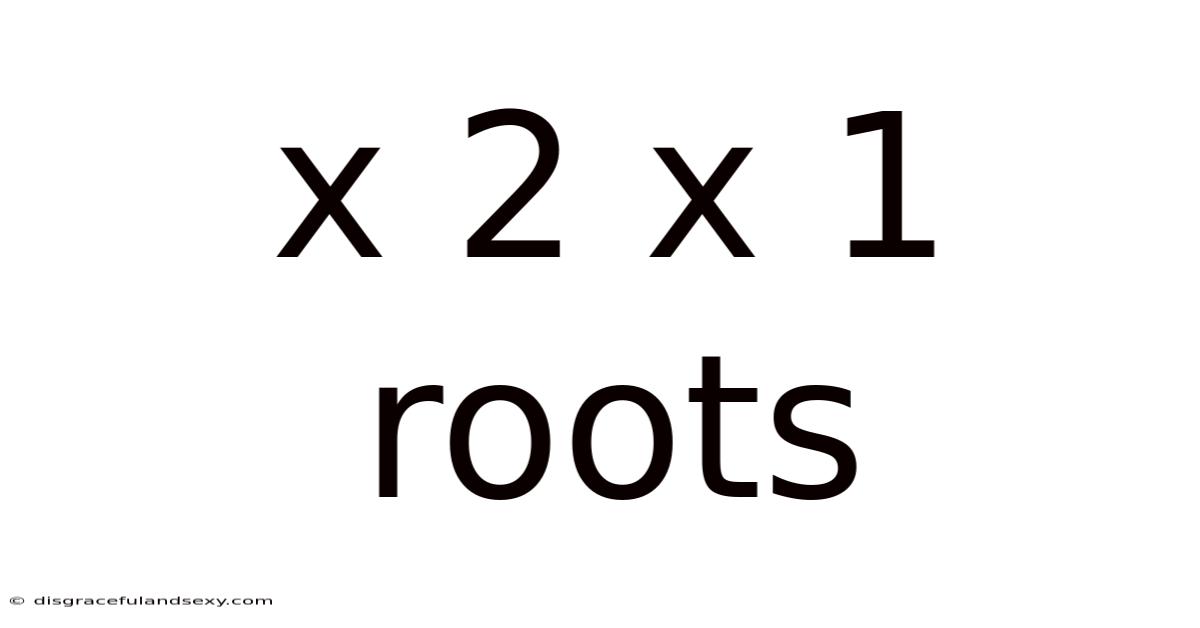
Unraveling the Mystery of X² + X - 2 = 0: Understanding Quadratic Equations and Their Roots
Finding the roots of a quadratic equation, like x² + x - 2 = 0, is a fundamental concept in algebra. This equation, and others like it, form the basis for understanding many real-world applications, from physics and engineering to finance and computer science. This practical guide will not only show you how to solve this specific equation but also break down the broader context of quadratic equations, their properties, and different methods of solving them. We'll explore the concepts of roots, factors, and the quadratic formula, ensuring you gain a thorough understanding of this important mathematical topic.
Understanding Quadratic Equations
A quadratic equation is a polynomial equation of the second degree, meaning the highest power of the variable (usually x) is 2. The general form of a quadratic equation is:
ax² + bx + c = 0
where a, b, and c are constants, and a is not equal to zero (if a were zero, it wouldn't be a quadratic equation). Because of that, the roots of the equation are the values of x that satisfy the equation, making the left-hand side equal to zero. These roots represent the points where the graph of the quadratic function (a parabola) intersects the x-axis The details matter here..
Our specific example, x² + x - 2 = 0, fits this general form with a = 1, b = 1, and c = -2.
Method 1: Factoring the Quadratic Equation
Factoring is often the quickest and easiest method to solve a quadratic equation, particularly when the equation has integer roots. The goal is to rewrite the equation as a product of two linear expressions. Let's factor x² + x - 2 = 0:
We look for two numbers that add up to b (1 in this case) and multiply to c (-2). Those numbers are 2 and -1. That's why, we can rewrite the equation as:
(x + 2)(x - 1) = 0
This equation is true if either (x + 2) = 0 or (x - 1) = 0. Solving these linear equations gives us the roots:
- x = -2
- x = 1
These are the two roots of the quadratic equation x² + x - 2 = 0. They represent the x-intercepts of the parabola defined by the function y = x² + x - 2.
Method 2: Using the Quadratic Formula
The quadratic formula is a powerful tool that can be used to solve any quadratic equation, even those that are difficult or impossible to factor easily. The formula is derived from completing the square method and provides a direct way to find the roots. The formula is:
x = [-b ± √(b² - 4ac)] / 2a
For our equation, x² + x - 2 = 0, we have a = 1, b = 1, and c = -2. Substituting these values into the quadratic formula:
x = [-1 ± √(1² - 4 * 1 * -2)] / (2 * 1) x = [-1 ± √(1 + 8)] / 2 x = [-1 ± √9] / 2 x = [-1 ± 3] / 2
This gives us two solutions:
- x = (-1 + 3) / 2 = 2 / 2 = 1
- x = (-1 - 3) / 2 = -4 / 2 = -2
As expected, we get the same roots as with the factoring method.
Method 3: Completing the Square
Completing the square is a technique used to manipulate a quadratic equation into a perfect square trinomial, making it easier to solve. This method is particularly useful when factoring is not straightforward.
Here's how to complete the square for x² + x - 2 = 0:
-
Move the constant term to the right side: x² + x = 2
-
Take half of the coefficient of x (which is 1), square it ((1/2)² = 1/4), and add it to both sides: x² + x + 1/4 = 2 + 1/4 x² + x + 1/4 = 9/4
-
Rewrite the left side as a perfect square: (x + 1/2)² = 9/4
-
Take the square root of both sides: x + 1/2 = ±√(9/4) = ±3/2
-
Solve for x: x = -1/2 ± 3/2 x = (-1 + 3) / 2 = 1 or x = (-1 - 3) / 2 = -2
Again, we arrive at the same roots: x = 1 and x = -2 It's one of those things that adds up. Surprisingly effective..
The Discriminant: Understanding the Nature of Roots
The expression inside the square root in the quadratic formula, b² - 4ac, is called the discriminant. The discriminant determines the nature of the roots of the quadratic equation:
-
b² - 4ac > 0: The equation has two distinct real roots. This is the case for x² + x - 2 = 0, as the discriminant is 9 (positive).
-
b² - 4ac = 0: The equation has exactly one real root (a repeated root). The parabola touches the x-axis at only one point Not complicated — just consistent. Nothing fancy..
-
b² - 4ac < 0: The equation has no real roots. The roots are complex conjugates (involving the imaginary unit i). The parabola does not intersect the x-axis That's the part that actually makes a difference..
Graphical Representation
The graph of the quadratic function y = x² + x - 2 is a parabola that opens upwards (since a is positive). Also, the roots, x = 1 and x = -2, are the x-intercepts of the parabola – the points where the parabola crosses the x-axis. Understanding the graphical representation helps visualize the solutions and their meaning That's the whole idea..
Applications of Quadratic Equations
Quadratic equations have numerous applications across various fields:
-
Physics: Calculating projectile motion, determining the trajectory of objects under gravity.
-
Engineering: Designing bridges, structures, and other architectural elements.
-
Finance: Modeling investment growth, calculating compound interest, and analyzing financial models And that's really what it comes down to. Less friction, more output..
-
Computer Science: Solving optimization problems, developing algorithms, and creating simulations.
-
Geometry: Calculating areas and volumes of shapes, solving geometric problems involving curves.
Frequently Asked Questions (FAQ)
Q: What if I can't factor the quadratic equation easily?
A: If factoring seems difficult, use the quadratic formula. It works for all quadratic equations Most people skip this — try not to..
Q: What does it mean if the discriminant is negative?
A: A negative discriminant indicates that the quadratic equation has no real roots; the roots are complex numbers That alone is useful..
Q: Can a quadratic equation have only one root?
A: Yes, if the discriminant is zero, the quadratic equation has exactly one real root (a repeated root) Nothing fancy..
Q: How do I know which method to use to solve a quadratic equation?
A: Try factoring first. If it's easy to factor, that's the quickest method. If factoring is difficult or impossible, use the quadratic formula or completing the square Most people skip this — try not to..
Q: What if the coefficient 'a' is zero?
A: If a is zero, the equation is no longer quadratic; it becomes a linear equation, which is much simpler to solve.
Conclusion
Solving quadratic equations like x² + x - 2 = 0 is a cornerstone of algebra. Understanding the different methods—factoring, the quadratic formula, and completing the square—empowers you to tackle a wide range of problems. And by grasping the concept of roots, the significance of the discriminant, and the various applications of quadratic equations, you'll develop a strong foundation in mathematics and its applications to real-world scenarios. Remember, practice is key to mastering these techniques. Practically speaking, work through various examples and challenge yourself to deepen your understanding of this essential mathematical concept. The more you practice, the more confident and proficient you will become in solving quadratic equations and appreciating their significance in various fields.
