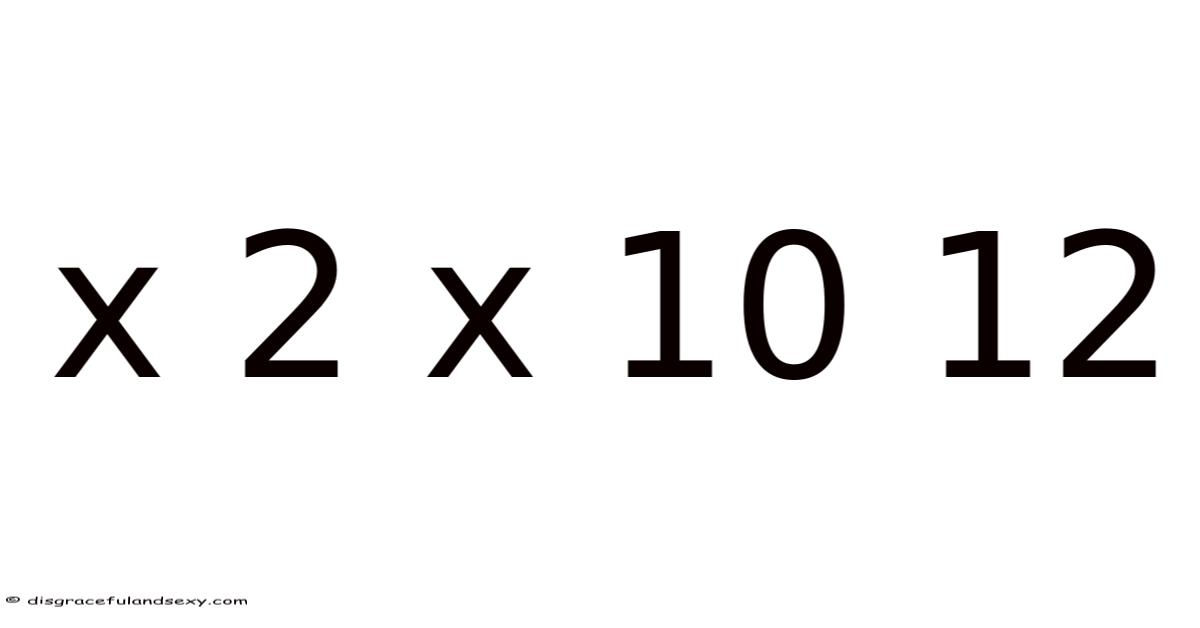
Decoding the Universe: Exploring the Significance of 10<sup>12</sup> in Scientific Contexts
The seemingly simple expression "x 2 x 10<sup>12</sup>" might appear unremarkable at first glance. Even so, this numerical representation holds profound implications across diverse scientific fields, signifying vast scales and magnitudes that shape our understanding of the universe. On top of that, this article digs into the significance of 10<sup>12</sup> (one trillion), exploring its presence in various scientific contexts, from the microscopic world of particles to the immense expanse of the cosmos. We'll unpack its meaning, illustrate its practical applications, and address common misconceptions surrounding this significant number.
Understanding Scientific Notation and 10<sup>12</sup>
Before we walk through the specific applications, let's briefly clarify the meaning of 10<sup>12</sup> within the framework of scientific notation. On the flip side, scientific notation is a standardized way of representing extremely large or extremely small numbers concisely. In real terms, in this case, 10<sup>12</sup> means 10 multiplied by itself twelve times, resulting in the number one trillion (1,000,000,000,000). Practically speaking, it utilizes powers of 10 to express magnitudes efficiently. The "x" in "x 2 x 10<sup>12</sup>" simply indicates multiplication; thus, the entire expression represents two trillion The details matter here..
The importance of scientific notation lies in its ability to simplify complex calculations and enhance readability, especially when dealing with numbers far beyond our everyday comprehension. It allows scientists to express vast quantities succinctly, making comparisons and computations more manageable Surprisingly effective..
10<sup>12</sup> in the Context of Particle Physics
In the realm of particle physics, 10<sup>12</sup> can represent significant quantities related to energy scales, particle interactions, and decay rates. As an example, the energy levels involved in certain particle collisions at large hadron colliders can reach magnitudes of tera-electronvolts (TeV), where one TeV is approximately 10<sup>12</sup> electronvolts (eV). Understanding these energy scales is crucial to unraveling the fundamental forces of nature and the behavior of elementary particles.
This changes depending on context. Keep that in mind.
Adding to this, certain particle decay processes may occur with probabilities expressed in terms of 10<sup>-12</sup> (one trillionth). This represents an extremely low probability, highlighting the rarity of such events. The study of such rare decay processes provides valuable insights into the underlying laws of physics.
10<sup>12</sup> and Astronomical Scales
The vastness of the universe demands the use of scientific notation to comprehend distances and magnitudes. The expression "x 2 x 10<sup>12</sup>" can represent various astronomical measurements. To give you an idea, the number could represent:
- Distance: The distance between two celestial bodies, perhaps within a specific galaxy cluster, could be on the order of several trillion kilometers.
- Mass: The mass of a particularly large asteroid or a small moon could be expressed in terms of trillions of kilograms.
- Number of Particles: The sheer number of particles, such as photons or cosmic rays, traversing a specific volume of space within a given timeframe could easily reach the trillion scale.
The scale of astronomical measurements necessitates the use of scientific notation for practical and comprehensible representation. Without it, calculations and comparisons become incredibly cumbersome Took long enough..
10<sup>12</sup> in Biology and Chemistry
Although less common than in physics and astronomy, 10<sup>12</sup> also appears in biological and chemical contexts:
- Cell Counts: The number of cells in a large organism, such as a human being, is in the order of trillions.
- Molecular Concentrations: Certain molecular concentrations in biological systems could also reach trillion-scale values, particularly in contexts where extremely high concentrations of specific molecules play critical roles.
- Chemical Reactions: In some chemical reactions, the rate of reaction or the number of molecules involved might attain trillion-level quantities.
While less frequent than in other fields, the presence of 10<sup>12</sup> in biology and chemistry demonstrates the ubiquitous nature of this numerical magnitude in quantifying various aspects of the natural world That's the whole idea..
10<sup>12</sup> and Technology
In the realm of technology, 10<sup>12</sup> appears in various contexts:
- Data Storage: The capacity of large data storage systems, such as massive data centers, often exceeds trillions of bytes (terabytes).
- Processing Power: The speed of high-performance computing systems might be expressed in terms of trillions of calculations per second (teraflops).
- Financial Transactions: The total volume of financial transactions processed globally in a given period could easily exceed trillions of monetary units.
Technological advancements continuously push the boundaries of what was once considered impossible, and as we strive for greater efficiency and speed, the presence of 10<sup>12</sup> and even larger orders of magnitude becomes increasingly common Worth keeping that in mind. Nothing fancy..
Common Misconceptions about 10<sup>12</sup>
Several common misconceptions surround the use and interpretation of 10<sup>12</sup>:
- Oversimplification: Sometimes, scientists may use 10<sup>12</sup> as an approximate value, ignoring smaller orders of magnitude for the sake of simplification. It's crucial to remember this approximation when interpreting such data.
- Unit Confusion: Failing to specify the units associated with 10<sup>12</sup> can lead to ambiguity and misinterpretations. Always carefully note the relevant units (e.g., meters, kilograms, seconds, etc.).
- Ignoring Uncertainty: Scientific measurements always involve some degree of uncertainty. While 10<sup>12</sup> may represent the best estimate, acknowledging the associated error bars is critical for a complete understanding.
Frequently Asked Questions (FAQ)
Q: What is the difference between 10<sup>12</sup> and 10<sup>-12</sup>?
A: 10<sup>12</sup> represents one trillion (a very large number), while 10<sup>-12</sup> represents one trillionth (a very small number). The negative exponent indicates a reciprocal Nothing fancy..
Q: How is 10<sup>12</sup> related to other prefixes in the metric system?
A: 10<sup>12</sup> corresponds to the prefix "tera" (T). As an example, 1 terabyte (TB) is equal to 10<sup>12</sup> bytes.
Q: Are there any natural phenomena that inherently involve 10<sup>12</sup>?
A: While not a fundamental constant like the speed of light, 10<sup>12</sup> emerges as a significant scale in many natural phenomena, particularly when dealing with large numbers of particles, vast distances, or significant energy levels. It's a consequence of the sheer scale of the universe and the processes within it No workaround needed..
Q: Why is scientific notation important for understanding 10<sup>12</sup>?
A: Scientific notation provides a concise and efficient way to represent extremely large numbers like 10<sup>12</sup>. Without it, working with such numbers would become incredibly cumbersome Less friction, more output..
Conclusion: The Ubiquity of 10<sup>12</sup>
So, to summarize, the seemingly simple expression "x 2 x 10<sup>12</sup>" unveils a profound significance across diverse scientific disciplines. From the subatomic realm to the astronomical scales, this numerical representation helps us grasp the vastness and complexity of the universe. Understanding scientific notation and the context in which 10<sup>12</sup> is used is crucial for interpreting scientific findings accurately. Still, the exploration of 10<sup>12</sup> highlights the power of mathematical tools in unraveling the mysteries of the natural world and advancing our technological capabilities. The continued exploration of these massive scales will undoubtedly lead to further breakthroughs in various fields of science and engineering Simple, but easy to overlook..
