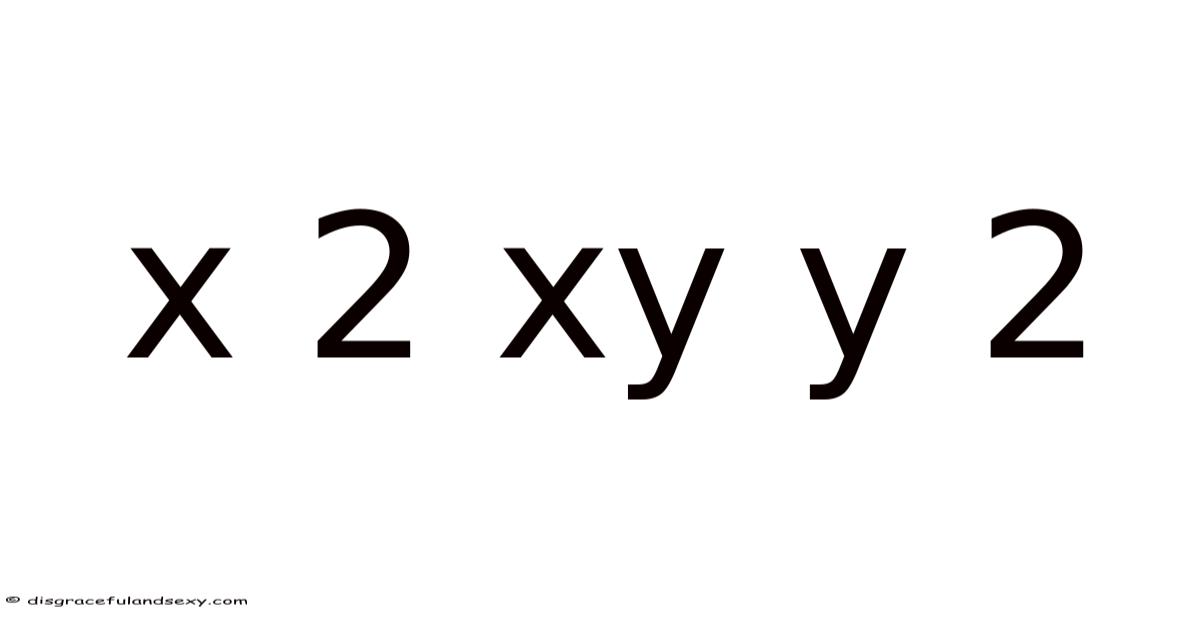
Understanding and Mastering x² + 2xy + y²: A Complete Guide
The expression x² + 2xy + y² is a fundamental concept in algebra, appearing frequently in various mathematical contexts. Day to day, understanding its properties and how to manipulate it is crucial for success in higher-level mathematics. In real terms, this practical guide will explore this expression from its basic factorization to its applications in geometry, calculus, and beyond. We will break down the concept in a clear and accessible manner, making it understandable for students of all levels.
I. Introduction: Recognizing a Perfect Square Trinomial
At first glance, x² + 2xy + y² might seem like a complex algebraic expression. On the flip side, it represents a specific and easily factorable pattern known as a perfect square trinomial. This means it can be expressed as the square of a binomial. Understanding this fundamental characteristic is the key to unlocking its various applications. The core of understanding this expression lies in recognizing the pattern and knowing how to factor it efficiently That's the part that actually makes a difference. Less friction, more output..
II. Factoring x² + 2xy + y²: The Simple Approach
The simplest and most direct way to understand x² + 2xy + y² is through factoring. Notice the pattern:
- x²: The square of x
- y²: The square of y
- 2xy: Twice the product of x and y
This structure perfectly matches the expansion of (x + y)². Let's demonstrate this using the FOIL method (First, Outer, Inner, Last):
(x + y)(x + y) = x² + xy + xy + y² = x² + 2xy + y²
Because of this, the factored form of x² + 2xy + y² is simply (x + y)². This seemingly simple factorization is incredibly powerful and underlies many mathematical processes Most people skip this — try not to..
III. Geometric Interpretation: Area of a Square
The expression x² + 2xy + y² can be elegantly visualized geometrically. Imagine a square with side length (x + y). The area of this square can be calculated as (x + y)².
- A square with side length x, having an area of x²
- A square with side length y, having an area of y²
- Two rectangles, each with sides x and y, each having an area of xy.
The total area of the large square is the sum of the areas of these four smaller regions: x² + xy + xy + y² = x² + 2xy + y². This demonstrates the equivalence between the algebraic expression and a geometric representation, reinforcing the understanding of the perfect square trinomial.
IV. Applications in Different Mathematical Fields
The seemingly simple expression x² + 2xy + y² has far-reaching applications in various branches of mathematics:
-
Algebra: This expression is fundamental in simplifying algebraic equations, solving quadratic equations, and manipulating polynomial expressions. Mastering its factorization is key to solving more complex problems. It's often used in completing the square, a technique frequently used to solve quadratic equations Simple as that..
-
Calculus: In calculus, the concept of a perfect square trinomial is used in differentiation and integration. Recognizing this pattern can simplify complex derivatives and integrals, making calculations more efficient. It appears in optimization problems and in finding critical points of functions.
-
Coordinate Geometry: In coordinate geometry, the expression is useful in calculating distances between points and determining the equations of circles and other geometric shapes. The distance formula, frequently used in coordinate geometry, often involves simplifying expressions that resemble this perfect square trinomial Not complicated — just consistent..
-
Physics: Many physical phenomena are described by mathematical models involving quadratic equations and thus work with the properties of perfect square trinomials. Examples include projectile motion and certain types of wave behavior.
-
Statistics: In statistical analysis, the expression finds its place in calculations related to variance and standard deviation, which often involve squaring and summing terms Simple as that..
V. Expanding the Concept: Variations and Extensions
While we've focused on x² + 2xy + y², understanding this core concept allows for the application to similar expressions. Consider these variations:
-
(x - y)²: This expands to x² - 2xy + y². The only difference is the negative sign in the middle term. This arises from the expansion of (x - y)(x - y).
-
(ax + by)²: This expands to a²x² + 2abxy + b²y². This demonstrates how the principle extends to expressions with coefficients. The structure remains the same; it's still a perfect square trinomial.
-
(x + y + z)²: Expanding this involves more terms, but the underlying principles are the same. It results in x² + y² + z² + 2xy + 2xz + 2yz. Understanding the base case (x+y)² helps approach this expansion systematically That's the part that actually makes a difference..
VI. Solving Equations Involving x² + 2xy + y²
Let’s see how the factorization helps in solving equations. Consider the equation:
x² + 2xy + y² = 9
Since x² + 2xy + y² = (x + y)², the equation simplifies to:
(x + y)² = 9
Taking the square root of both sides gives:
x + y = ±3
This shows that the solution depends on the values of x and y, and it can be a positive or negative 3, reflecting the nature of square roots. Further information or constraints would be needed to solve for specific values of x and y.
VII. Frequently Asked Questions (FAQ)
-
Q: What if the expression is x² - 2xy + y²? A: This is also a perfect square trinomial, but it factors to (x - y)². The negative sign in the middle term indicates subtraction within the binomial That's the whole idea..
-
Q: Can I always factor a trinomial as a perfect square? A: No. Only trinomials that fit the pattern of a perfect square (a² + 2ab + b² or a² - 2ab + b²) can be factored this way.
-
Q: How do I identify a perfect square trinomial? A: Check if the first and last terms are perfect squares and if the middle term is twice the product of the square roots of the first and last terms Most people skip this — try not to..
VIII. Conclusion: The Power of Pattern Recognition
Mastering the concept of x² + 2xy + y² goes beyond simply memorizing a formula. It’s about understanding the underlying patterns and applying them to various mathematical situations. The ability to recognize perfect square trinomials is a valuable skill that significantly simplifies complex algebraic manipulations and opens doors to more advanced mathematical concepts. In practice, through practice and a deeper understanding of its geometric interpretation and applications, you’ll develop a stronger foundation in algebra and beyond. Remember, understanding this expression is not merely about solving equations; it's about understanding the fundamental relationships between algebraic expressions and their geometric and practical interpretations. This knowledge provides a cornerstone for more advanced mathematical exploration.
