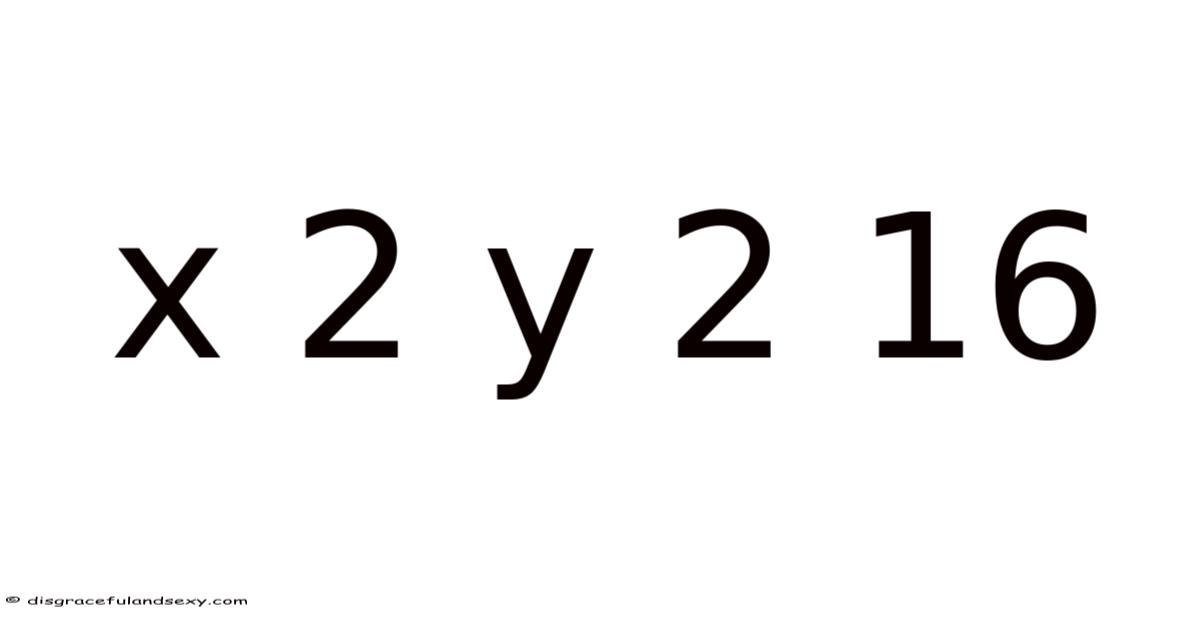
Unraveling the Mystery: A Deep Dive into x² + y² = 16
This article explores the equation x² + y² = 16, delving into its geometrical representation, algebraic properties, and various applications. Understanding this equation provides a foundational grasp of analytic geometry and its relationship to algebraic expressions. We'll move beyond a simple solution and uncover the rich mathematical concepts hidden within this seemingly straightforward equation. By the end, you'll not only understand the equation's solution but also appreciate its significance in a wider mathematical context Still holds up..
Introduction: More Than Just an Equation
At first glance, x² + y² = 16 appears simple. It's a quadratic equation in two variables. Still, its implications extend far beyond basic algebra. Day to day, this equation describes a fundamental geometric shape, allowing us to bridge the gap between algebra and geometry. This connection is a cornerstone of analytic geometry, a branch of mathematics that uses algebraic methods to study geometric objects. Understanding this equation unlocks insights into circles, their properties, and their applications in various fields. The key to unlocking this understanding lies in recognizing the equation's connection to the distance formula and the Pythagorean theorem.
This is where a lot of people lose the thread Most people skip this — try not to..
The Geometrical Interpretation: The Circle's Embrace
The equation x² + y² = 16 represents a circle centered at the origin (0,0) with a radius of 4. Let's break this down. Recall the distance formula: d = √((x₂ - x₁)² + (y₂ - y₁)²) which calculates the distance between two points (x₁, y₁) and (x₂, y₂).
If we consider the distance from the origin (0,0) to any point (x,y) on the circle, that distance is simply the radius, 'r'. That's why, we can rewrite the distance formula as:
r = √((x - 0)² + (y - 0)²) = √(x² + y²)
Since the radius of our circle is 4, we have:
4 = √(x² + y²)
Squaring both sides gives us our original equation:
x² + y² = 16
This demonstrates the intimate relationship between the equation and the circle. Each point (x, y) that satisfies the equation lies exactly 4 units away from the origin, thus forming the circle And that's really what it comes down to..
Algebraic Properties and Solutions
Solving the equation directly for x or y isn't straightforward in a way that provides a single solution. Instead, it offers an infinite number of solutions, each corresponding to a point on the circle. We can, however, express y in terms of x (or vice versa):
y = ±√(16 - x²)
This shows that for every value of x within the interval [-4, 4], there are two corresponding values of y (except at x = ±4, where y = 0). This reflects the symmetry of the circle about the x and y axes. Similarly, we can express x in terms of y:
And yeah — that's actually more nuanced than it sounds.
x = ±√(16 - y²)
This again highlights the circle's symmetry. These equations let us generate points on the circle. Even so, for instance, if x = 0, then y = ±4, giving us the points (0, 4) and (0, -4). If x = 3, then y = ±√7, giving us the points (3, √7) and (3, -√7). This process can be continued to generate countless points on the circle Small thing, real impact..
Extending the Understanding: Variations and Transformations
The equation x² + y² = 16 is a specific case of a more general equation for a circle: (x - h)² + (y - k)² = r², where (h, k) is the center and r is the radius. Our equation is simply a circle centered at the origin (0,0) with a radius of 4. Understanding this general form allows us to analyze variations and transformations:
The official docs gloss over this. That's a mistake.
- Changing the Radius: Increasing the value on the right-hand side (e.g., x² + y² = 25) increases the radius to 5. Decreasing it (e.g., x² + y² = 9) decreases the radius to 3.
- Shifting the Center: Adding or subtracting values within the parentheses shifts the circle's center. As an example, (x - 2)² + (y + 1)² = 16 represents a circle with a center at (2, -1) and a radius of 4.
- Scaling: Multiplying the entire equation by a constant will scale the circle.
These transformations provide a deeper understanding of how algebraic manipulations affect geometric shapes Not complicated — just consistent..
Applications: Beyond the Classroom
The equation x² + y² = 16, and its generalizations, have widespread applications in various fields:
- Physics and Engineering: Circular motion, projectile trajectories, and wave propagation often involve equations similar to this. Understanding this equation is crucial for analyzing these phenomena.
- Computer Graphics: Drawing and manipulating circles in computer graphics relies heavily on the equation of a circle and its transformations.
- Navigation and Surveying: Determining locations and distances often involves geometric calculations based on circular relationships.
- Astronomy: Analyzing orbits and celestial movements utilizes the principles embedded in the equation of a circle and more complex conic sections.
Solving Related Problems: A Practical Approach
Let's consider some related problems to solidify our understanding:
Problem 1: Find the points of intersection between the circle x² + y² = 16 and the line y = x And that's really what it comes down to..
Solution: Substitute y = x into the equation of the circle:
x² + x² = 16 2x² = 16 x² = 8 x = ±√8 = ±2√2
Since y = x, the points of intersection are (2√2, 2√2) and (-2√2, -2√2) Worth knowing..
Problem 2: Determine if the point (3, 2) lies inside, outside, or on the circle x² + y² = 16.
Solution: Substitute the point's coordinates into the equation:
3² + 2² = 9 + 4 = 13
Since 13 < 16, the point (3, 2) lies inside the circle Small thing, real impact..
Problem 3: Find the equation of a circle with a center at (1, -2) and passing through the point (4, 1).
Solution: First, calculate the radius using the distance formula between the center (1, -2) and the point (4, 1):
r = √((4 - 1)² + (1 - (-2))²) = √(3² + 3²) = √18
The equation of the circle is then (x - 1)² + (y + 2)² = 18 Easy to understand, harder to ignore..
Frequently Asked Questions (FAQ)
- Q: What if the equation was x² + y² = -16? A: This equation has no real solutions. The sum of two squares cannot be negative.
- Q: Can this equation be graphed in 3D space? A: While the equation itself only defines a 2D shape (a circle), it could be considered a cylinder extending infinitely along the z-axis in 3D space.
- Q: How does this relate to trigonometry? A: Points on the circle can be represented using trigonometric functions (x = r cos θ, y = r sin θ), where θ is the angle.
Conclusion: A Foundation for Further Exploration
The equation x² + y² = 16, seemingly simple, provides a rich foundation for understanding fundamental concepts in algebra and geometry. Its geometrical interpretation as a circle allows us to bridge the gap between algebraic expressions and visual representations. The equation's applications extend far beyond the classroom, demonstrating its relevance in various scientific and technological fields. So by mastering the concepts presented here, you've laid a solid groundwork for exploring more advanced topics in mathematics, such as conic sections, vector geometry, and calculus. Remember, the beauty of mathematics lies in its ability to connect seemingly disparate concepts, and this equation serves as a perfect example of that connection. Continue exploring, questioning, and most importantly, enjoy the journey of mathematical discovery!
