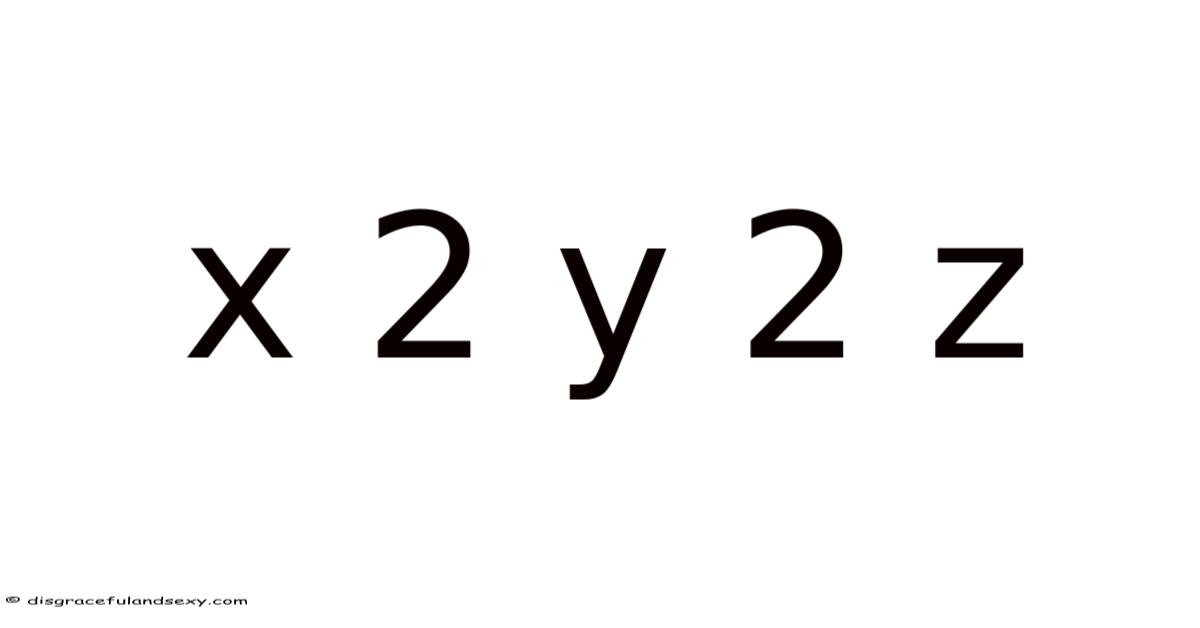
Delving Deep into x² + y² + z²: Exploring its Mathematical Significance and Applications
The expression x² + y² + z² represents the sum of the squares of three variables, x, y, and z. This seemingly simple algebraic expression holds significant mathematical weight, appearing in various branches of mathematics and finding practical applications in diverse fields. Practically speaking, this article will explore the multifaceted nature of x² + y² + z², examining its geometric interpretation, its role in various mathematical theorems and formulas, and its practical applications in physics and engineering. Understanding this expression unlocks a deeper comprehension of fundamental mathematical concepts and their real-world relevance Small thing, real impact..
Introduction: A Geometric Perspective
At its core, x² + y² + z² has a profound geometric interpretation. Consider a three-dimensional Cartesian coordinate system. The variables x, y, and z represent the coordinates of a point in this space. The expression x² + y² + z² then represents the square of the distance of this point from the origin (0, 0, 0). Which means this is a direct consequence of the Pythagorean theorem extended to three dimensions. On the flip side, the Pythagorean theorem, in its familiar two-dimensional form, states that in a right-angled triangle, the square of the hypotenuse (the longest side) is equal to the sum of the squares of the other two sides. In three dimensions, we can envision a right-angled tetrahedron, where the distance from the origin to the point (x, y, z) is the hypotenuse, and the distances along the x, y, and z axes are the other sides.
r² = x² + y² + z²
This simple equation forms the basis for many applications, from calculating distances in space to understanding the behavior of physical phenomena.
Mathematical Applications: Beyond Geometry
The expression x² + y² + z² appears prominently in various mathematical contexts. Let's examine some key areas:
-
Vector Analysis: In vector analysis, x, y, and z can represent the components of a vector in three-dimensional space. x² + y² + z² then represents the magnitude squared of this vector. This is crucial for calculating vector lengths, dot products, and other vector operations. The magnitude of a vector provides vital information about its size or strength, essential in numerous applications in physics and engineering And that's really what it comes down to..
-
Number Theory: In number theory, x² + y² + z² plays a role in studying sums of squares. Problems involving representing integers as sums of three squares have been extensively investigated, leading to deep results about the structure of integers and their factorization. Take this case: Legendre's three-square theorem states that a natural number can be represented as the sum of three squares of integers if and only if it is not of the form 4<sup>a</sup>(8b + 7) for nonnegative integers a and b. This demonstrates the expression's power in analyzing the fundamental properties of numbers.
-
Multivariable Calculus: This expression is frequently encountered in multivariable calculus, particularly in topics like partial differentiation, multiple integrals, and gradient calculations. Take this: finding the gradient of a scalar field often involves calculating partial derivatives with respect to x, y, and z, often leading to expressions involving x² + y² + z². This is fundamental for understanding how a function changes in three-dimensional space.
-
Linear Algebra: In linear algebra, the expression might appear in the context of quadratic forms. A quadratic form is a homogeneous polynomial of degree two. x² + y² + z² is a simple example of a positive definite quadratic form, meaning it's always positive except when x=y=z=0. This property has important consequences in various applications, including optimization problems.
Practical Applications in Physics and Engineering
The versatility of x² + y² + z² extends far beyond theoretical mathematics. Here are some prominent examples in various fields:
-
Classical Mechanics: In classical mechanics, x, y, and z might represent the Cartesian coordinates of a particle. x² + y² + z² then represents the square of the distance of the particle from the origin. This is crucial for calculating kinetic energy, potential energy, and the trajectory of the particle under the influence of forces. The concept forms the basis for understanding projectile motion, planetary orbits, and many other physical phenomena Easy to understand, harder to ignore..
-
Electromagnetism: In electromagnetism, x² + y² + z² can appear in calculations related to electric and magnetic fields. As an example, the electric potential due to a point charge is inversely proportional to the distance from the charge, which is related to the square root of x² + y² + z². Understanding this relationship is vital for solving electromagnetic problems and designing electrical devices Simple, but easy to overlook..
-
Computer Graphics: In computer graphics, x, y, and z represent the three-dimensional coordinates of a point in virtual space. Calculating distances between points, which involves x² + y² + z², is essential for rendering 3D images, creating realistic lighting effects, and detecting collisions in games and simulations. The formula is fundamental to the geometric computations underlying computer-generated imagery Not complicated — just consistent. Surprisingly effective..
-
Signal Processing: In signal processing, the expression can be used to represent the energy of a signal in three dimensions. The magnitude of a signal, often determined using a variation of this formula, is crucial for signal analysis and noise reduction. Signal processing underpins numerous technologies, from communication systems to medical imaging.
Extending the Concept: Beyond Three Dimensions
While we've primarily focused on three dimensions, the concept of summing squares readily extends to higher dimensions. In n-dimensional space, the analogous expression is x₁² + x₂² + ... Plus, + xₙ². On the flip side, this represents the square of the Euclidean distance from the origin to a point (x₁, x₂, ... , xₙ) in n-dimensional space. Here's the thing — this generalization finds applications in advanced mathematical areas such as linear algebra, topology, and abstract algebra. Many theoretical concepts and practical applications rely on this broader understanding of the concept That's the part that actually makes a difference. Worth knowing..
Frequently Asked Questions (FAQ)
Q1: What is the significance of the square root of x² + y² + z²?
A1: The square root of x² + y² + z², denoted as √(x² + y² + z²), represents the actual distance of a point (x, y, z) from the origin in three-dimensional space. This is a crucial quantity for determining lengths, distances, and magnitudes in various applications.
Q2: Can x, y, and z be complex numbers?
A2: Yes, x, y, and z can be complex numbers. Still, the geometric interpretation as a distance in three-dimensional real space no longer directly applies. The expression still holds mathematical significance in complex analysis and related fields Surprisingly effective..
Q3: Are there alternative ways to represent the distance from the origin?
A3: Yes, other coordinate systems like cylindrical or spherical coordinates can also be used to represent the distance from the origin. The choice of coordinate system depends on the specific problem and its symmetry.
Q4: How is x² + y² + z² related to spheres?
A4: The equation x² + y² + z² = r² represents a sphere centered at the origin with radius r. This equation defines all points that are a distance r from the origin. This relationship is fundamental in geometric calculations and computer graphics.
Q5: What are some advanced applications of this expression?
A5: Advanced applications include general relativity (where it relates to spacetime intervals), quantum mechanics (in calculations involving wave functions), and various areas of theoretical physics and mathematics exploring higher-dimensional spaces.
Conclusion: A Foundation for Further Exploration
The expression x² + y² + z² serves as a fundamental building block in numerous mathematical and scientific disciplines. Now, its seemingly simple form belies its profound significance, providing a crucial link between abstract mathematical concepts and their practical applications in the real world. From basic geometry to advanced physics, this expression underpins our understanding of space, distance, and the behavior of physical systems. This article has only scratched the surface of its vast applications, encouraging further exploration and deeper understanding of its mathematical power and real-world relevance. Because of that, its ubiquity underscores its importance as a cornerstone of mathematical knowledge and a key tool for solving problems across various fields. Further study will undoubtedly reveal even more facets of this seemingly simple yet incredibly powerful expression.
