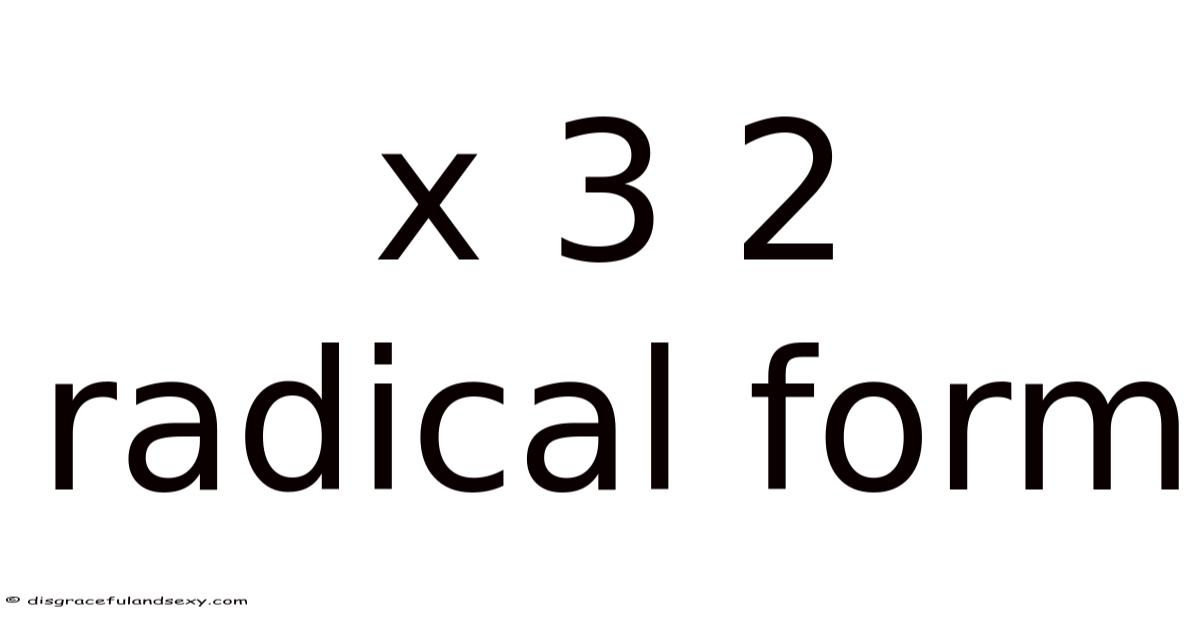
Understanding and Simplifying Expressions in the Form x³√2: A practical guide
Many mathematical problems involve simplifying expressions containing radicals. That's why understanding how to manipulate and simplify expressions like x³√2 is crucial for various mathematical applications, from algebra to calculus. Consider this: this full breakdown will break down the concept, explore different approaches to simplification, and address common questions. We will explore the intricacies of this specific form, looking at different scenarios and providing practical examples to solidify your understanding And that's really what it comes down to. Nothing fancy..
Understanding the Components: x³√2
The expression x³√2 consists of two main components:
-
x³: This represents 'x' raised to the power of 3, also known as 'x cubed'. It signifies x multiplied by itself three times (x * x * x). The exponent, 3, is a crucial part of the expression's overall behavior Simple, but easy to overlook..
-
³√2: This is a cube root, specifically the cube root of 2. A cube root is a number that, when multiplied by itself three times, results in the number under the radical sign (in this case, 2). The cube root of 2 is an irrational number, meaning it cannot be expressed as a simple fraction and its decimal representation goes on forever without repeating. Approximately, ³√2 ≈ 1.26.
Simplifying Expressions with x³√2: Different Scenarios
The simplification process for x³√2 depends largely on the context and any additional information provided. Let’s examine several scenarios:
Scenario 1: Simplifying when 'x' is a known value.
If 'x' is a specific number, the simplification is straightforward. We simply substitute the value of 'x' and calculate the result.
- Example: If x = 2, then the expression becomes 2³√2 = 8³√2 ≈ 10.08. There's no further simplification possible in this case unless we approximate the cube root of 2 to a decimal value.
Scenario 2: Factoring and simplifying when 'x' is an expression involving radicals.
If 'x' itself contains radicals, we might be able to simplify by factoring. Let's look at an example:
- Example: Let's say x = ³√8. Then the expression becomes (³√8)³√2. Since ³√8 = 2, the expression simplifies to 2³√2. This is the simplest form.
Scenario 3: Simplifying when 'x' is a variable.
When 'x' remains a variable, the expression x³√2 is already in its simplest form. In real terms, there's no further algebraic simplification possible without additional information or context within a larger equation. That said, you might need to manipulate this expression within a larger mathematical problem The details matter here..
Scenario 4: Dealing with equations involving x³√2.
Consider situations where x³√2 is part of an equation. In such cases, the simplification strategy will depend on the nature of the equation Not complicated — just consistent..
- Example: Solve for x: x³√2 = 16. To solve this, we divide both sides by ³√2: x³ = 16/³√2. Then, we take the cube root of both sides to solve for x: x = ³√(16/³√2). This expression can be further simplified using properties of exponents and radicals, but it's beyond the scope of a basic simplification.
Advanced Simplification Techniques
While x³√2 is generally considered simplified in its basic form, more advanced mathematical techniques might offer further reduction depending on the context. These include:
-
Rationalizing the denominator: This technique is primarily used when the cube root of 2 is in the denominator of a fraction. By multiplying the numerator and denominator by a suitable expression, we can remove the radical from the denominator. Still, this isn't directly applicable to our base expression x³√2.
-
Using properties of exponents: Recall that (aⁿ)ᵐ = aⁿᵐ. This property can be utilized when dealing with more complex expressions that might include x³√2 as a component The details matter here..
-
Approximation: If a decimal approximation is acceptable, we can approximate the cube root of 2 (approximately 1.26) to obtain a numerical result Practical, not theoretical..
A Deeper Dive into Cube Roots and Radicals
Understanding cube roots and radicals more generally is essential for mastering expressions like x³√2. Here's a recap of key concepts:
-
Radicals: A radical expression represents a root of a number. The symbol √ is called a radical sign, and the number under the radical sign is called the radicand. The small number written above the radical sign (like the 3 in ³√) is called the index, which indicates the type of root (square root, cube root, etc.) Simple, but easy to overlook..
-
Cube Roots: A cube root of a number 'a' is a number 'x' such that x³ = a. Every real number has exactly one real cube root. As an example, ³√8 = 2 because 2³ = 8.
-
Properties of Radicals: Several properties govern operations with radicals, including:
- √(a * b) = √a * √b
- √(a/b) = √a / √b
- (√a)ⁿ = √(aⁿ)
Frequently Asked Questions (FAQs)
Q: Is x³√2 always irrational?
A: Yes, unless x is zero. The cube root of 2 is irrational, meaning it cannot be expressed as a fraction of two integers. Multiplying it by x³ (where x is not zero) doesn't change this irrationality. The product will only be rational if x³ exactly cancels out the irrationality of ³√2, a scenario highly unlikely unless a specific equation dictates it.
Q: Can x³√2 be negative?
A: Yes, if x is a negative number. As an example, if x = -1, then x³√2 = (-1)³√2 = -³√2 ≈ -1.26.
Q: How do I solve an equation that includes x³√2?
A: Solving equations that involve x³√2 depends on the structure of the equation. Generally, you'll use algebraic manipulations, often involving isolating the term with x³√2 and then solving for x. This often involves raising both sides of the equation to the power of 3 (to eliminate the cube root) or other manipulations appropriate to the situation.
Q: What are some real-world applications of simplifying expressions like x³√2?
A: While this specific expression might not have direct, readily apparent real-world applications, the underlying concepts of radicals and simplifying expressions are incredibly useful in various fields, including:
- Engineering: Calculations involving volumes, areas, and other geometric properties often involve radicals.
- Physics: Formulas in physics, such as those related to energy, motion, and wave phenomena, frequently contain radical expressions.
- Computer Graphics: Mathematical transformations and algorithms used in computer graphics heavily rely on manipulating expressions containing radicals.
Conclusion
Simplifying expressions like x³√2 requires a solid grasp of algebraic principles and the properties of radicals and exponents. Think about it: remember to always consider the context and use appropriate algebraic methods to reach the simplest, most accurate form of your expression. While the expression itself is often in its simplest form when 'x' is a simple variable, understanding the different scenarios and advanced techniques empowers you to tackle more complex problems involving this type of expression. By mastering these techniques, you'll enhance your problem-solving skills in mathematics and many related fields And that's really what it comes down to. Still holds up..
