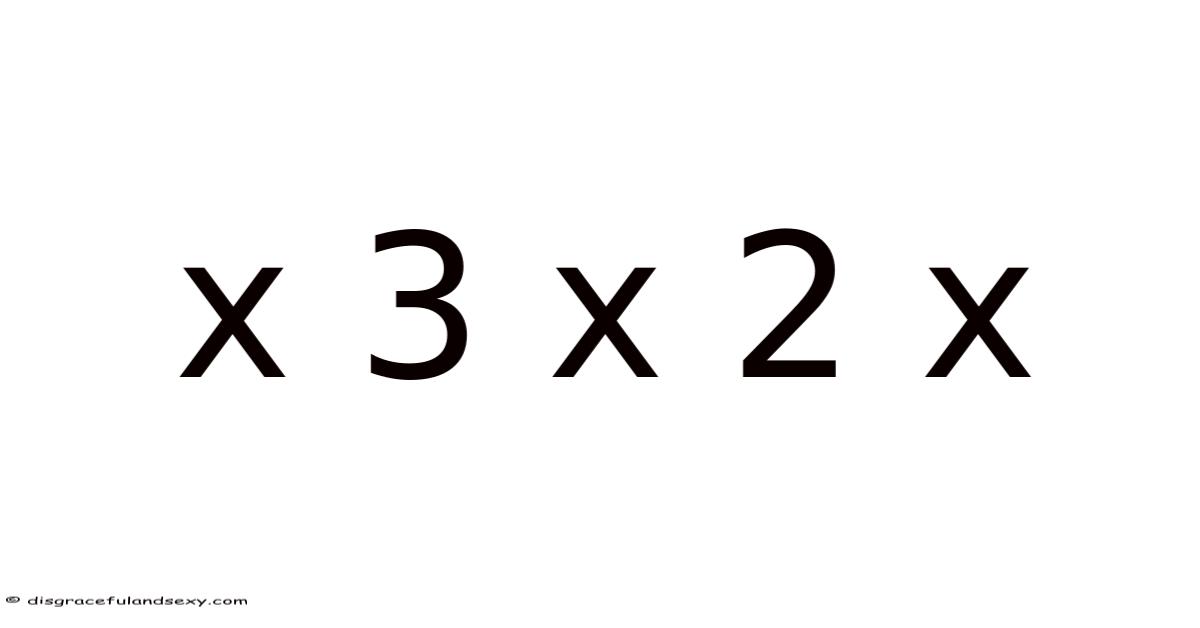
Decoding the Mystery: A Deep Dive into the Expression "x 3 x 2 x"
This article explores the mathematical expression "x 3 x 2 x," examining its various interpretations, potential meanings within different contexts, and the underlying principles involved. Even so, we will move beyond a simple calculation and dig into the richer possibilities embedded within this seemingly straightforward notation. On top of that, understanding this requires considering the context, the nature of 'x', and the implications of the repeated multiplication. Let's unpack this mystery together.
Understanding the Fundamentals: What Does 'x' Represent?
The core of understanding "x 3 x 2 x" lies in defining 'x'. In mathematics, 'x' is most commonly used as a variable. This is the most likely interpretation in our expression. A variable is a symbol, usually a letter, that represents an unknown quantity or a value that can change. On the flip side, depending on the context, 'x' could also represent other things Took long enough..
- In algebra: 'x' is frequently employed to represent an unknown number within an equation. We solve the equation to find the value of 'x'.
- In programming: 'x' could be a variable storing a specific data type (integer, string, etc.). Its value is defined and modified within the program's code.
- In a specific problem or scenario: 'x' may represent a measurable quantity like distance, time, or speed. The expression would then be a representation of a real-world calculation.
Without further context, we will assume 'x' represents a numerical variable in a standard algebraic sense That's the part that actually makes a difference..
Interpreting the Expression: Multiple Possibilities
The expression "x 3 x 2 x" can be interpreted in several ways, each leading to a different mathematical result. The ambiguity arises from the lack of explicit operators and the nature of implicit multiplication.
1. Sequential Multiplication: The most straightforward interpretation involves treating this as a continuous multiplication: x * 3 * x * 2 * x. This simplifies to 6x³. This is the likely interpretation if we are dealing with standard algebraic notation And that's really what it comes down to. Which is the point..
2. Polynomial Expression: It's possible to interpret this as a polynomial expression, though it's not the most conventional representation. It might represent a polynomial of degree three, but needs further clarification. To give you an idea, if it represents coefficients of terms in a polynomial, it requires more detail. A more explicit representation might be something like: 3x² + 2x That's the part that actually makes a difference..
3. Contextual Interpretation: The meaning of the expression will drastically change depending on the context. Take this case: imagine 'x' represents the side of a rectangular prism. Then, "x 3 x 2 x" might represent a volume calculation, requiring careful consideration of what each 'x' and the numbers 2 and 3 represent in the physical dimensions Turns out it matters..
4. Matrix Multiplication (Advanced): In linear algebra, 'x' could represent a matrix. Even so, for simple multiplication like this, matrices would need to have compatible dimensions for the multiplication to be valid. The "x 3 x 2 x" notation is far from standard for matrix operations Simple as that..
Illustrative Examples: Bringing it to Life
Let's consider a few scenarios to showcase how the interpretation of "x 3 x 2 x" changes depending on the context.
Example 1: Simple Algebraic Calculation
If 'x' = 5, then the expression "x 3 x 2 x" interpreted as sequential multiplication becomes:
5 * 3 * 5 * 2 * 5 = 750
Example 2: Area Calculation
Suppose 'x' represents the length of a square. Let's say the expression represents the area of three squares with sides x, and two rectangles with dimensions x and 3 and x and 2. It would then be: x² + x² + x² + 3x + 2x = 3x² + 5x. This is a completely different interpretation from sequential multiplication Worth knowing..
Example 3: Volume of a Rectangular Prism
If 'x' is the length of one side of a rectangular prism, and we have three sides of length x, and two sides of length 2x and 3x, the volume calculation could, hypothetically, be represented as a simplified form of (x)(2x)(3x) or 6x³. This is different from our initial sequential interpretation Most people skip this — try not to..
Mathematical Operations: A Closer Look
Let's further explore the mathematical operations implied in the expression:
- Multiplication: The fundamental operation here is multiplication. Repeated multiplication is also known as exponentiation (in the case of 6x³).
- Implied Multiplication: The expression uses implicit multiplication, meaning the multiplication signs are not explicitly written between variables and numbers (e.g., 3x means 3 * x). This is a standard convention in algebra.
It's crucial to understand the order of operations (PEMDAS/BODMAS) to correctly solve these types of expressions. In this case, multiplication proceeds from left to right But it adds up..
Addressing Potential Ambiguities and Misinterpretations
The expression "x 3 x 2 x" is inherently ambiguous without further context. To avoid misinterpretations, a clearer and more unambiguous notation should be used. For example:
- Explicit Multiplication: Use explicit multiplication symbols (*) to eliminate any doubt: x * 3 * x * 2 * x.
- Parentheses: Use parentheses to group terms and clarify the order of operations. This is particularly important in more complex expressions.
- Contextual Clarity: Always provide a clear explanation of what 'x' represents and the intended operation.
Frequently Asked Questions (FAQ)
Q1: What is the most likely interpretation of "x 3 x 2 x"?
A1: The most probable interpretation, given standard algebraic notation, is sequential multiplication, resulting in 6x³ That's the whole idea..
Q2: Can "x 3 x 2 x" represent a polynomial?
A2: It could be interpreted as a polynomial, but this interpretation requires significant assumptions and context not explicitly provided in the original expression. It's not a standard way of representing a polynomial.
Q3: How do I avoid ambiguity when writing similar expressions?
A3: Always use explicit multiplication signs (*) and parentheses to clearly indicate the order of operations and group terms.
Q4: What if 'x' represents a matrix?
A4: If 'x' were a matrix, the expression would only be meaningful if matrix multiplication rules were followed, and the dimensions of 'x' allowed for such operations. The expression as given doesn't conform to conventional matrix notation.
Conclusion: The Importance of Clear Notation
The seemingly simple expression "x 3 x 2 x" highlights the critical importance of clear mathematical notation. Worth adding: ambiguity can lead to significant misinterpretations and incorrect results. Practically speaking, always strive for clarity in your mathematical writing by using explicit operations, appropriate grouping symbols, and providing sufficient context. So while we've explored various possibilities, understanding the context is key in accurately interpreting and solving such expressions. This seemingly simple exploration has revealed the depth and complexity within seemingly straightforward mathematical notations, reminding us of the crucial role of precise and unambiguous communication in mathematics. Remember to always define your variables and clearly express your intended operations to avoid confusion and ensure accurate calculations.
