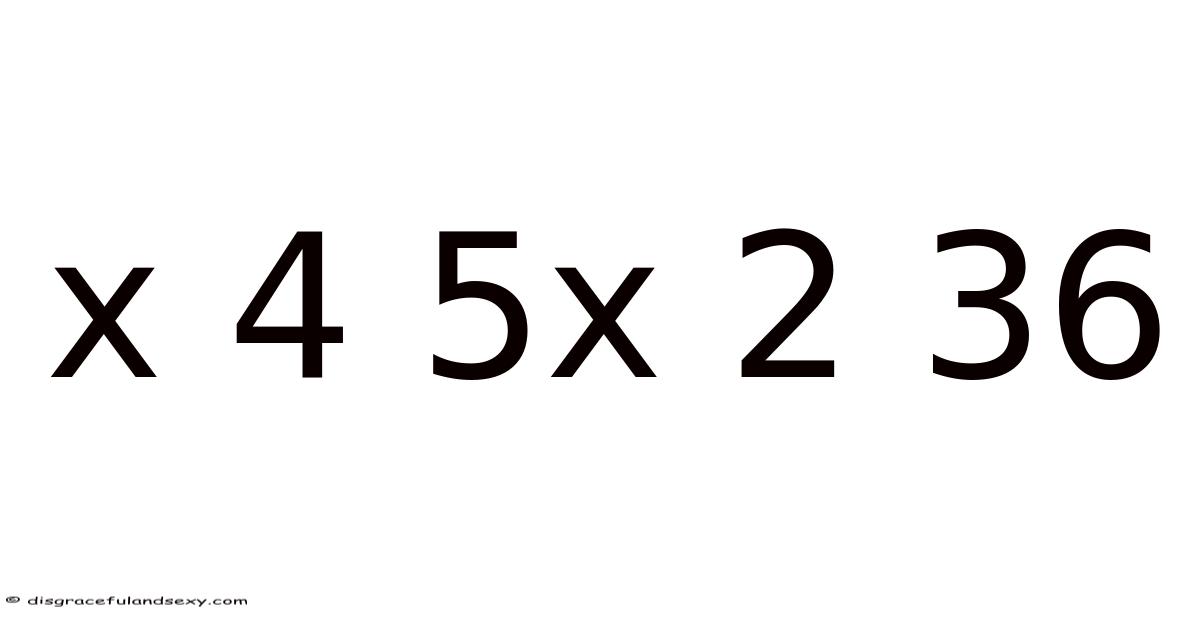
Decoding the Mathematical Puzzle: x 4 5x 2 36
This article explores the intriguing mathematical puzzle "x 4 5x 2 36," delving into its potential interpretations, solution strategies, and the underlying mathematical principles involved. We'll examine various approaches to solving this seemingly simple yet deceptively complex problem, highlighting the importance of order of operations and algebraic reasoning. Whether you're a seasoned mathematician or a curious beginner, this exploration will enhance your understanding of mathematical problem-solving techniques Most people skip this — try not to..
Understanding the Problem: Different Interpretations
The expression "x 4 5x 2 36" presents an ambiguity that lies at the heart of its challenge. The lack of explicit operators between the numbers and the variable 'x' allows for multiple interpretations. This ambiguity highlights the critical importance of precise mathematical notation.
- Interpretation 1: Linear Equation
One interpretation assumes the expression represents a linear equation. In this case, we can rewrite it as: 4x + 5x + 2 = 36. This is a straightforward algebraic equation that can be solved using basic algebraic manipulation.
- Interpretation 2: Polynomial Equation
Another interpretation treats the expression as a polynomial equation. This would involve considering potential exponents and higher-order terms, significantly increasing the complexity of the problem. Here's a good example: it could be interpreted as: 4x * 5x + 2 = 36, which simplifies to a quadratic equation.
People argue about this. Here's where I land on it.
- Interpretation 3: Mixed Operations
A third possibility involves a combination of operations. The expression might represent a sequence of operations applied to the variable 'x', requiring careful consideration of the order of operations (PEMDAS/BODMAS).
Solving the Equation: A Step-by-Step Guide
Let's focus on solving the most straightforward interpretation, assuming it's a linear equation: 4x + 5x + 2 = 36.
Step 1: Combine like terms:
The equation contains two terms with the variable 'x'. Combining these terms simplifies the equation:
9x + 2 = 36
Step 2: Isolate the variable:
To isolate the variable 'x', we need to eliminate the constant term (+2). We can achieve this by subtracting 2 from both sides of the equation:
9x + 2 - 2 = 36 - 2
9x = 34
Step 3: Solve for x:
Finally, to find the value of 'x', we divide both sides of the equation by 9:
9x / 9 = 34 / 9
x = 34/9 or approximately 3.78
Which means, based on this interpretation, the solution to the equation is x = 34/9 Simple as that..
Exploring Other Interpretations: Polynomial Equations
Let's get into a more complex interpretation: assuming the expression is a polynomial equation, specifically 4x * 5x + 2 = 36.
Step 1: Simplify the equation:
First, we simplify the multiplication of the terms with 'x':
20x² + 2 = 36
Step 2: Isolate the quadratic term:
Subtracting 2 from both sides, we isolate the quadratic term:
20x² = 34
Step 3: Solve for x²:
Dividing both sides by 20, we solve for x²:
x² = 34/20 = 17/10
Step 4: Solve for x:
Taking the square root of both sides, we find the possible values for x:
x = ±√(17/10)
This results in two possible solutions for x: a positive and a negative value. This highlights how a seemingly simple change in interpretation can lead to significantly different solutions And it works..
The Importance of Order of Operations (PEMDAS/BODMAS)
The ambiguity in the original expression underscores the importance of following the order of operations, often remembered by the acronyms PEMDAS (Parentheses, Exponents, Multiplication and Division, Addition and Subtraction) or BODMAS (Brackets, Orders, Division and Multiplication, Addition and Subtraction). Without clear parentheses or explicit operators, different interpretations of the order of operations are possible, leading to multiple solutions. This emphasizes the need for precise mathematical notation to avoid ambiguity.
Applications in Different Mathematical Fields
The principles demonstrated in solving this puzzle are fundamental across various mathematical fields. The concepts of linear and polynomial equations, order of operations, and algebraic manipulation are crucial in:
-
Algebra: Solving equations and inequalities is a core component of algebra. This puzzle directly applies algebraic techniques to find the value of an unknown variable.
-
Calculus: Understanding the behavior of functions, especially polynomial functions, is crucial in calculus. The different interpretations of the puzzle highlight the importance of defining the function precisely before analyzing its properties The details matter here..
-
Linear Algebra: Systems of linear equations are frequently encountered in linear algebra. The linear interpretation of the puzzle is a simple case of a system of equations.
-
Computer Science: Algorithms for solving equations and performing symbolic manipulation are fundamental in computer science, particularly in areas like computational algebra and numerical analysis.
Frequently Asked Questions (FAQ)
Q1: What is the single definitive answer to the puzzle "x 4 5x 2 36"?
A1: There isn't a single definitive answer. The lack of explicit operators allows for multiple interpretations, leading to different solutions depending on how the expression is interpreted (linear equation, polynomial equation, etc.) But it adds up..
Q2: Why is precise mathematical notation important?
A2: Precise notation removes ambiguity and ensures that everyone interprets the mathematical expression in the same way, avoiding confusion and errors. The puzzle highlights the potential for multiple interpretations when notation is unclear Worth keeping that in mind..
Q3: What are the different ways to approach solving this type of puzzle?
A3: Different approaches depend on the interpretation of the expression. Approaches include using basic algebraic manipulation for linear equations, applying quadratic formula or factoring for quadratic equations, and more advanced techniques for higher-order polynomial equations Practical, not theoretical..
Q4: How can I improve my skills in solving mathematical puzzles?
A4: Practice is key! Think about it: start with simpler problems and gradually work towards more challenging ones. Understanding the underlying mathematical principles, like order of operations and algebraic manipulation, is essential. Also, explore different problem-solving strategies and consider the multiple interpretations.
Conclusion: Embracing the Ambiguity and Learning from It
The puzzle "x 4 5x 2 36" serves as a valuable illustration of the importance of precise mathematical notation and the multiple interpretations that can arise from ambiguous expressions. And while there isn't a single "correct" answer, the process of exploring different interpretations and applying various solution strategies significantly enhances our understanding of fundamental mathematical principles. This puzzle, therefore, is not merely a problem to be solved but a learning opportunity to appreciate the subtleties of mathematical language and the power of clear communication. Which means the experience of grappling with this ambiguity strengthens problem-solving skills and fosters a deeper appreciation for the beauty and precision of mathematics. The journey of exploration is as valuable as the solution itself That's the whole idea..
