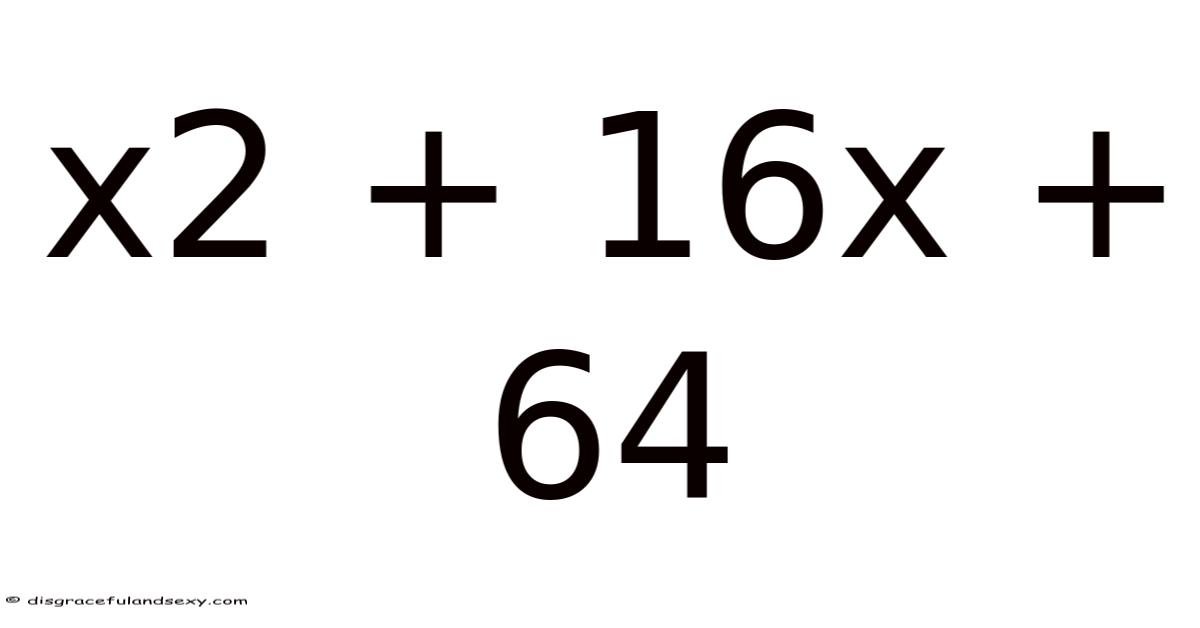
Unveiling the Secrets of x² + 16x + 64: A Deep Dive into Quadratic Expressions
Understanding quadratic expressions is fundamental to mastering algebra. This article will walk through the specifics of the quadratic expression x² + 16x + 64, exploring its factorization, graphical representation, and practical applications. We’ll go beyond simply providing the solution and examine the underlying mathematical principles, equipping you with a comprehensive understanding of this seemingly simple equation. By the end, you'll not only know how to solve it but also why the methods work.
I. Introduction: What is a Quadratic Expression?
A quadratic expression is a polynomial of degree two, meaning the highest power of the variable (in this case, 'x') is 2. It generally takes the form ax² + bx + c, where 'a', 'b', and 'c' are constants (numbers), and 'a' is not equal to zero. Our expression, x² + 16x + 64, fits this form perfectly, with a = 1, b = 16, and c = 64. Understanding quadratic expressions is crucial in various fields, including physics (projectile motion), engineering (designing parabolic structures), and economics (modeling growth and decay) Worth knowing..
II. Factoring the Quadratic Expression: Finding the Roots
Factoring a quadratic expression means rewriting it as a product of two simpler expressions. This process is vital for solving quadratic equations (where the expression is set equal to zero) and understanding the expression's roots (the values of x that make the expression equal to zero).
There are several ways to factor x² + 16x + 64. Let's explore the most common methods:
A. Recognizing a Perfect Square Trinomial:
This is the easiest and most elegant method for factoring x² + 16x + 64. Observe the following:
- The first term, x², is the square of x (x² = x * x).
- The last term, 64, is the square of 8 (64 = 8 * 8).
- The middle term, 16x, is twice the product of x and 8 (16x = 2 * x * 8).
This pattern signifies a perfect square trinomial, which factors as (a + b)² = a² + 2ab + b². In our case, a = x and b = 8. Therefore:
x² + 16x + 64 = (x + 8)²
What this tells us is the expression is a perfect square, the result of squaring the binomial (x + 8).
B. Using the Quadratic Formula:
The quadratic formula is a general method for solving quadratic equations of the form ax² + bx + c = 0. The formula is:
x = [-b ± √(b² - 4ac)] / 2a
While we're not directly solving an equation here, we can use the formula to find the roots, and then use the roots to factor the expression. For x² + 16x + 64, a = 1, b = 16, and c = 64. Plugging these values into the quadratic formula gives:
Some disagree here. Fair enough The details matter here..
x = [-16 ± √(16² - 4 * 1 * 64)] / (2 * 1) x = [-16 ± √(256 - 256)] / 2 x = -16 / 2 x = -8
Since we get only one root, -8, this confirms that the expression is a perfect square trinomial. The factored form is (x - (-8))(x - (-8)) = (x + 8)(x + 8) = (x + 8)² No workaround needed..
C. Factoring by Trial and Error:
This method involves finding two numbers that add up to 'b' (16) and multiply to 'c' (64). Practically speaking, in this case, those numbers are 8 and 8 (8 + 8 = 16 and 8 * 8 = 64). This leads us back to the same factored form: (x + 8)(x + 8) = (x + 8)².
III. Graphical Representation: Visualizing the Parabola
Quadratic expressions represent parabolas when graphed on a Cartesian plane. In real terms, the parabola of x² + 16x + 64 is a simple parabola that opens upwards because the coefficient of x² (a = 1) is positive. Worth adding: its vertex (the lowest point) lies on the x-axis because the expression is a perfect square. The x-coordinate of the vertex is given by -b/2a = -16/(2*1) = -8. The y-coordinate is 0 because when x = -8, the expression equals zero: (-8 + 8)² = 0.
The parabola is symmetrical about the vertical line x = -8. On the flip side, this line of symmetry is crucial for understanding the parabola’s shape and behavior. The graph is tangent to the x-axis at the point (-8, 0), meaning it touches the axis at only one point – its root.
People argue about this. Here's where I land on it.
IV. Solving Quadratic Equations: Applying the Factored Form
The factored form of x² + 16x + 64, which is (x + 8)², is incredibly useful for solving quadratic equations. If we set the expression equal to zero:
(x + 8)² = 0
We can easily solve for x:
x + 8 = 0 x = -8
This demonstrates that the only solution (or root) to the equation x² + 16x + 64 = 0 is x = -8. The parabola’s intersection with the x-axis confirms this visually.
V. Applications in Real-World Scenarios
The concepts explored here have practical applications across various disciplines:
- Physics: The trajectory of a projectile (like a ball thrown into the air) can be modeled using a quadratic equation. Understanding quadratic expressions is crucial for determining the maximum height and range of the projectile.
- Engineering: Parabolic shapes are used in the design of bridges, antennas, and reflectors. Understanding the properties of quadratic equations aids in the optimization of these designs.
- Economics: Quadratic functions can model cost, revenue, and profit relationships. Finding the vertex of a parabola allows businesses to identify the optimal production level or pricing strategy for maximizing profit.
- Computer Graphics: Quadratic curves are used extensively in computer graphics to create smooth, curved lines and surfaces.
VI. Expanding Our Understanding: Beyond the Basics
While we've focused on x² + 16x + 64, the principles discussed apply to all quadratic expressions. The methods of factoring (perfect square trinomials, quadratic formula, trial and error) and the graphical representation of parabolas remain consistent. The key differences lie in the values of a, b, and c, which affect the shape, position, and roots of the parabola. Take this: a negative value of 'a' would result in a parabola that opens downwards.
VII. Frequently Asked Questions (FAQ)
Q1: What if the quadratic expression wasn't a perfect square trinomial?
If the expression didn't fit the perfect square trinomial pattern, you'd need to use the quadratic formula or factoring by trial and error. The quadratic formula always works, while factoring by trial and error is more efficient for simpler expressions.
Q2: Can a quadratic equation have more than two roots?
No, a quadratic equation can have at most two distinct real roots, or one repeated root (as in our example).
Q3: What is the significance of the discriminant (b² - 4ac)?
The discriminant determines the nature of the roots. If b² - 4ac > 0, there are two distinct real roots. If b² - 4ac = 0, there is one repeated real root (as in our case). If b² - 4ac < 0, there are no real roots (the roots are complex numbers) And that's really what it comes down to..
Q4: How can I improve my skills in factoring quadratic expressions?
Practice is key! Try factoring various quadratic expressions with different values of a, b, and c. Start with simpler examples and gradually increase the complexity.
VIII. Conclusion: Mastering Quadratic Expressions
Understanding x² + 16x + 64 and its associated principles provides a solid foundation for mastering quadratic expressions more broadly. Day to day, remember, the journey to mastering algebra is one of continuous learning and practice. The ability to factor, graph, and solve quadratic equations is indispensable across various disciplines. By applying the methods described here, you can confidently tackle more complex quadratic expressions and appreciate their significance in the world around us. Keep exploring, keep questioning, and keep solving!
