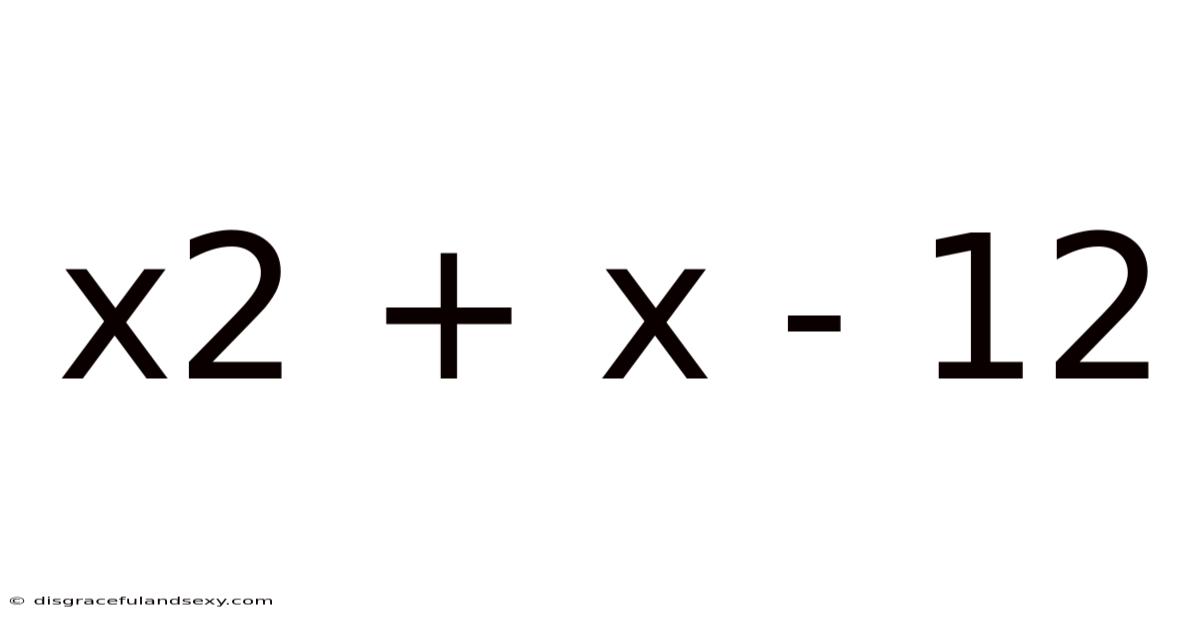
Exploring the Quadratic Expression: x² + x - 12
This article digs into the fascinating world of quadratic expressions, focusing specifically on the equation x² + x - 12. Understanding this seemingly simple equation unlocks a deeper understanding of algebra and its applications in numerous fields. We'll explore various methods for solving this equation, examining its roots, factoring techniques, and the underlying mathematical principles. We will cover everything from basic factorization to more advanced concepts, ensuring a comprehensive understanding for readers of all levels.
Understanding Quadratic Equations
Before diving into the specifics of x² + x - 12, let's establish a foundational understanding of quadratic equations. The general form of a quadratic equation is ax² + bx + c = 0, where 'a', 'b', and 'c' are constants, and 'a' is not equal to zero. A quadratic equation is a polynomial equation of the second degree, meaning the highest power of the variable (usually 'x') is 2. Our specific equation, x² + x - 12, fits this general form with a = 1, b = 1, and c = -12.
Factoring the Quadratic Expression: x² + x - 12
Factoring is a crucial technique in algebra, allowing us to simplify expressions and solve equations. The goal of factoring is to rewrite the expression as a product of simpler expressions. For x² + x - 12, we're looking for two binomials that multiply to give us the original expression.
This process involves finding two numbers that add up to the coefficient of the 'x' term (which is 1 in our case) and multiply to the constant term (-12). Let's consider the pairs of factors of -12:
- 1 and -12
- -1 and 12
- 2 and -6
- -2 and 6
- 3 and -4
- -3 and 4
The pair that adds up to 1 is 4 and -3. Which means, we can factor x² + x - 12 as follows:
(x + 4)(x - 3)
To verify this factorization, we can expand the expression: (x + 4)(x - 3) = x² - 3x + 4x - 12 = x² + x - 12. This confirms that our factorization is correct.
Solving the Quadratic Equation: x² + x - 12 = 0
Now that we have factored the quadratic expression, we can use it to solve the quadratic equation x² + x - 12 = 0. Since the product of two factors is zero, at least one of the factors must be zero. This gives us two separate equations:
- x + 4 = 0
- x - 3 = 0
Solving these linear equations gives us the roots (or solutions) of the quadratic equation:
- x = -4
- x = 3
Which means, the solutions to the equation x² + x - 12 = 0 are x = -4 and x = 3. These are the x-intercepts of the parabola represented by the quadratic function y = x² + x - 12.
Graphical Representation of x² + x - 12
Visualizing the quadratic equation can provide a deeper understanding of its behavior. The graph of y = x² + x - 12 is a parabola. The vertex of the parabola is the lowest point (or highest point if the parabola opens downwards). This leads to the x-intercepts of the parabola are the points where the parabola intersects the x-axis; these are the solutions we found earlier (x = -4 and x = 3). The y-intercept is where the parabola intersects the y-axis; this occurs when x = 0, giving y = -12 Not complicated — just consistent..
The parabola opens upwards because the coefficient of the x² term (a = 1) is positive. Understanding the parabola's shape and key points (vertex, x-intercepts, y-intercept) provides valuable insight into the equation's behavior.
The Quadratic Formula: An Alternative Approach
While factoring is a convenient method for solving quadratic equations, it's not always possible to factor a quadratic expression easily. The quadratic formula provides a more general method for finding the roots of any quadratic equation of the form ax² + bx + c = 0:
x = [-b ± √(b² - 4ac)] / 2a
For our equation, x² + x - 12 = 0, we have a = 1, b = 1, and c = -12. Plugging these values into the quadratic formula, we get:
x = [-1 ± √(1² - 4 * 1 * -12)] / (2 * 1) x = [-1 ± √(49)] / 2 x = [-1 ± 7] / 2
This gives us the same solutions as before:
x = (-1 + 7) / 2 = 3 x = (-1 - 7) / 2 = -4
The Discriminant: Understanding the Nature of Roots
The expression inside the square root in the quadratic formula, b² - 4ac, is called the discriminant. The discriminant provides information about the nature of the roots of the quadratic equation:
- b² - 4ac > 0: The equation has two distinct real roots.
- b² - 4ac = 0: The equation has one real root (a repeated root).
- b² - 4ac < 0: The equation has two complex roots (roots involving the imaginary unit 'i').
In our case, the discriminant is 1² - 4 * 1 * -12 = 49, which is greater than 0. This confirms that our equation has two distinct real roots, as we found earlier.
Completing the Square: Another Method of Solving
Completing the square is another technique for solving quadratic equations. This method involves manipulating the equation to create a perfect square trinomial, which can then be easily factored. The steps involved are:
- Move the constant term to the right side: x² + x = 12
- Take half of the coefficient of the x term, square it, and add it to both sides: Half of 1 is 1/2, and (1/2)² = 1/4. So we add 1/4 to both sides: x² + x + 1/4 = 12 + 1/4
- Factor the left side as a perfect square: (x + 1/2)² = 49/4
- Take the square root of both sides: x + 1/2 = ±7/2
- Solve for x: x = -1/2 ± 7/2. This gives x = 3 and x = -4.
Again, we obtain the same solutions as before.
Applications of Quadratic Equations
Quadratic equations are not merely abstract mathematical concepts; they have numerous practical applications in various fields:
- Physics: Calculating projectile motion, determining the trajectory of objects under gravity.
- Engineering: Designing structures, optimizing shapes and dimensions.
- Economics: Modeling supply and demand, analyzing market trends.
- Computer graphics: Creating curved shapes and animations.
Frequently Asked Questions (FAQ)
Q: What are the roots of the equation x² + x - 12 = 0?
A: The roots are x = 3 and x = -4 And that's really what it comes down to. Nothing fancy..
Q: How many roots does a quadratic equation have?
A: A quadratic equation can have two real roots, one real root (repeated), or two complex roots But it adds up..
Q: What is the discriminant and what does it tell us?
A: The discriminant is b² - 4ac. It determines the nature of the roots (real or complex, distinct or repeated) Small thing, real impact..
Q: Can all quadratic equations be factored easily?
A: No, some quadratic equations are difficult or impossible to factor using simple methods. The quadratic formula or completing the square provide more general solutions.
Conclusion
The seemingly simple quadratic equation x² + x - 12 offers a gateway to understanding a wide range of algebraic concepts. Mastering these techniques is essential for further advancement in mathematics and related fields. On top of that, the principles discussed here extend to more complex quadratic equations and have far-reaching applications across many disciplines. Through factoring, the quadratic formula, completing the square, and graphical representation, we've explored various methods for solving this equation and gaining a deeper understanding of its properties. The exploration of this single equation serves as a microcosm of the power and elegance of algebraic methods.
