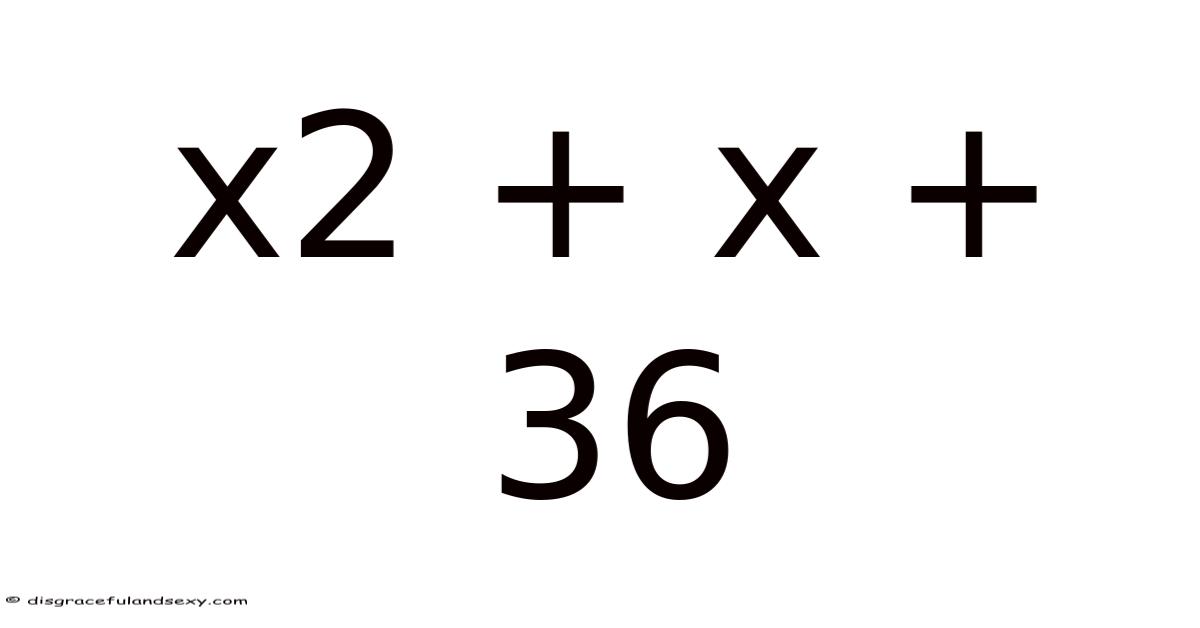
Exploring the Quadratic Expression x² + x + 36: A Deep Dive
The seemingly simple quadratic expression, x² + x + 36, opens doors to a fascinating world of mathematical concepts. So while it might appear straightforward at first glance, delving into its properties reveals intricacies related to factoring, solving quadratic equations, completing the square, the discriminant, and graphical representation. Worth adding: this comprehensive exploration aims to unravel the mysteries hidden within this seemingly simple expression, providing a detailed analysis suitable for students and enthusiasts alike. We will cover its factoring, solutions, graphing, and related concepts The details matter here..
I. Understanding Quadratic Expressions
Before diving into the specifics of x² + x + 36, let's establish a foundational understanding of quadratic expressions. A quadratic expression is a polynomial of degree two, meaning the highest power of the variable (in this case, x) is 2. Worth adding: the general form of a quadratic expression is ax² + bx + c, where a, b, and c are constants, and a ≠ 0. In our specific case, a = 1, b = 1, and c = 36. Understanding this general form is crucial for applying various mathematical techniques Nothing fancy..
No fluff here — just what actually works.
II. Attempting to Factor x² + x + 36
Factoring a quadratic expression involves rewriting it as a product of two simpler expressions. This is often achieved by finding two numbers that add up to the coefficient of x (b) and multiply to the constant term (c). Let's attempt this with x² + x + 36:
We need two numbers that add up to 1 and multiply to 36. Here's the thing — we can explore the possible pairs of factors of 36: (1, 36), (2, 18), (3, 12), (4, 9), (6, 6). That said, there are no such real numbers. None of these pairs sum to 1. This indicates that x² + x + 36 is irreducible over the real numbers; it cannot be factored into linear expressions with real coefficients.
III. Solving the Quadratic Equation x² + x + 36 = 0
Since factoring isn't possible using real numbers, we must use other methods to solve the quadratic equation x² + x + 36 = 0. The most common methods include:
-
Quadratic Formula: This formula provides the solutions for any quadratic equation of the form ax² + bx + c = 0:
x = [-b ± √(b² - 4ac)] / 2a
Substituting a = 1, b = 1, and c = 36, we get:
x = [-1 ± √(1² - 4 * 1 * 36)] / 2 * 1 x = [-1 ± √(-143)] / 2
Notice that the discriminant (b² - 4ac = -143) is negative. This signifies that the solutions are complex numbers, involving the imaginary unit i, where i² = -1.
Because of this, the solutions are:
x = (-1 + i√143) / 2 and x = (-1 - i√143) / 2
-
Completing the Square: This method involves manipulating the equation to create a perfect square trinomial.
x² + x + 36 = 0 x² + x = -36 x² + x + (1/4) = -36 + (1/4) (Adding (b/2)² = (1/2)² = 1/4 to both sides) (x + 1/2)² = -143/4 x + 1/2 = ±√(-143/4) x = -1/2 ± (i√143) / 2
This method yields the same complex solutions as the quadratic formula.
IV. The Discriminant and Nature of Roots
The discriminant, b² - 4ac, matters a lot in determining the nature of the roots (solutions) of a quadratic equation:
- If b² - 4ac > 0: The equation has two distinct real roots.
- If b² - 4ac = 0: The equation has one real root (a repeated root).
- If b² - 4ac < 0: The equation has two distinct complex roots (conjugate pairs).
In our case, b² - 4ac = -143 < 0, confirming that x² + x + 36 = 0 has two distinct complex roots, as we found using the quadratic formula and completing the square.
V. Graphical Representation
The graph of the quadratic function y = x² + x + 36 is a parabola. Still, since the coefficient of x² (a = 1) is positive, the parabola opens upwards. The vertex of the parabola represents the minimum value of the function.
Not obvious, but once you see it — you'll see it everywhere Worth keeping that in mind..
x = -1 / (2 * 1) = -1/2
Substituting this into the equation, we find the y-coordinate:
y = (-1/2)² + (-1/2) + 36 = 1/4 - 1/2 + 36 = 35.75
Which means, the vertex of the parabola is (-1/2, 35.75). Crucially, because the parabola opens upwards and the y-intercept (when x=0) is 36, the parabola never intersects the x-axis. This visually confirms that there are no real roots, aligning with our earlier findings Worth knowing..
VI. Complex Numbers and Their Significance
The fact that x² + x + 36 = 0 yields complex roots highlights the importance of extending the number system beyond real numbers. The complex roots we found are conjugate pairs, meaning they have the same real part but opposite imaginary parts. They provide solutions to equations that are impossible to solve using only real numbers. Complex numbers are essential in various branches of mathematics, physics, and engineering. This is a characteristic property of quadratic equations with real coefficients.
VII. Applications of Quadratic Equations
Quadratic equations and their solutions have numerous applications in various fields:
- Physics: Projectile motion, oscillations, and many other physical phenomena are modeled using quadratic equations.
- Engineering: Designing structures, calculating forces, and analyzing systems often involve solving quadratic equations.
- Economics: Modeling economic growth, optimizing profits, and analyzing market trends put to use quadratic functions.
- Computer Graphics: Parabolas and quadratic curves are fundamental in creating realistic shapes and animations.
VIII. Further Exploration
This analysis provides a comprehensive overview of x² + x + 36. Even so, further explorations could involve:
- Investigating the properties of complex numbers and their geometric representation in the complex plane.
- Exploring the relationship between the coefficients of a quadratic equation and the nature of its roots.
- Studying the application of quadratic equations in specific real-world problems.
- Examining other methods for solving quadratic equations, such as using numerical techniques for approximating solutions.
IX. Conclusion
The seemingly simple quadratic expression x² + x + 36 reveals a rich tapestry of mathematical concepts. So its irreducibility over real numbers leads us into the realm of complex numbers, showcasing their importance in solving seemingly unsolvable equations. On the flip side, understanding the discriminant, the quadratic formula, completing the square, and the graphical representation of the function provides a complete picture of its properties. This exploration emphasizes the interconnectedness of various mathematical ideas and the power of extending our mathematical toolkit to solve problems that initially appear intractable. The journey into the depths of this quadratic expression serves as a microcosm of the broader mathematical landscape, highlighting the beauty and elegance of mathematics itself Worth knowing..
