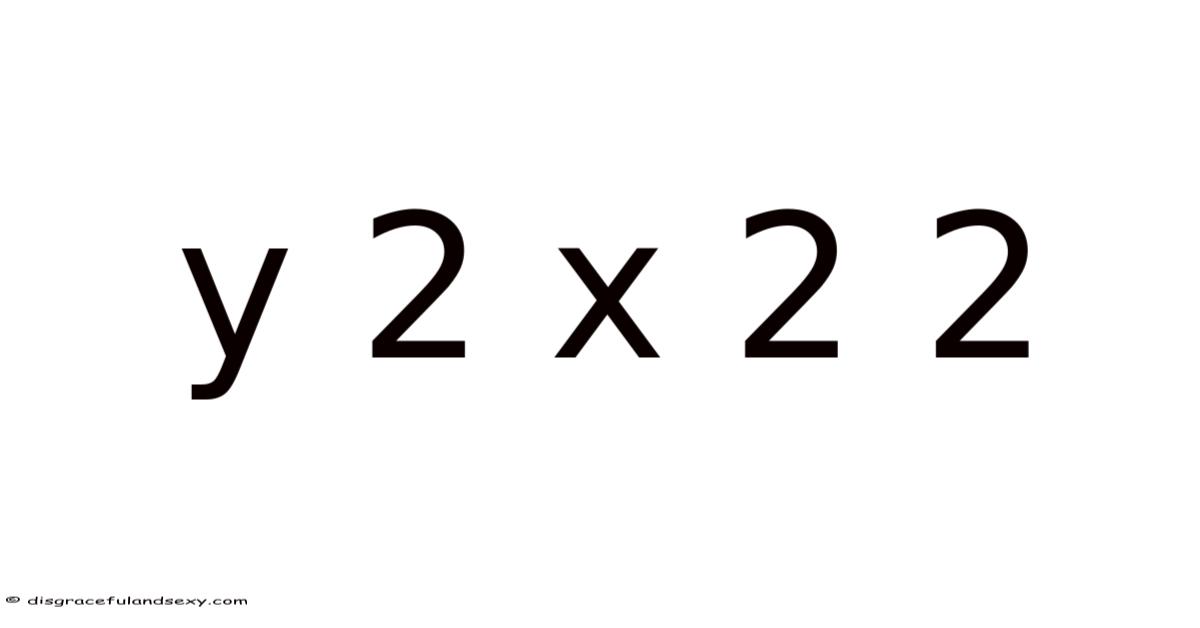
Decoding Y = 2x² + 2x + 2: A full breakdown to Quadratic Equations
This article explores the quadratic equation Y = 2x² + 2x + 2, delving into its properties, graphing techniques, and practical applications. Also, we will break down the equation step-by-step, making it accessible to students and anyone interested in understanding the fundamentals of algebra and quadratic functions. This guide will cover key concepts such as identifying the coefficients, finding the vertex, determining the axis of symmetry, understanding the discriminant, and exploring real-world applications.
Introduction: Understanding Quadratic Equations
A quadratic equation is an equation of the second degree, meaning the highest power of the variable (in this case, x) is 2. Which means our specific equation, Y = 2x² + 2x + 2, fits this general form, with a = 2, b = 2, and c = 2. On top of that, the general form of a quadratic equation is Y = ax² + bx + c, where a, b, and c are constants, and a is not equal to zero. Understanding these coefficients is crucial to analyzing the equation's behavior and characteristics.
1. Identifying Key Features of the Quadratic Equation Y = 2x² + 2x + 2
-
Coefficient a (2): This positive coefficient indicates that the parabola opens upwards. This means the graph will have a minimum point (vertex) and will extend infinitely upwards. The magnitude of 'a' (2 in this case) affects the parabola's "steepness"; a larger absolute value of 'a' results in a narrower parabola No workaround needed..
-
Coefficient b (2): This coefficient influences the parabola's horizontal position and the x-coordinate of the vertex. It also contributes to the equation of the axis of symmetry That alone is useful..
-
Coefficient c (2): This is the y-intercept. It represents the point where the parabola intersects the y-axis (when x = 0). In our equation, the parabola intersects the y-axis at the point (0, 2).
2. Finding the Vertex of the Parabola
The vertex represents the minimum or maximum point of the parabola. For a parabola that opens upwards (like ours), it's the minimum point. The x-coordinate of the vertex can be found using the formula: x = -b / 2a.
x = -2 / (2 * 2) = -2 / 4 = -0.5
Now, to find the y-coordinate, substitute this x-value back into the original equation:
Y = 2(-0.That's why 5) + 2 = 2(0. 25) - 1 + 2 = 0.Now, 5)² + 2(-0. 5 - 1 + 2 = 1 And it works..
That's why, the vertex of the parabola is (-0.5, 1.5).
3. Determining the Axis of Symmetry
The axis of symmetry is a vertical line that divides the parabola into two symmetrical halves. In our case, the axis of symmetry is x = -0.This leads to its equation is simply x = the x-coordinate of the vertex. 5.
4. Calculating the Discriminant
The discriminant (Δ) helps determine the nature of the roots (solutions) of the quadratic equation. It is calculated using the formula: Δ = b² - 4ac. For our equation:
Δ = (2)² - 4(2)(2) = 4 - 16 = -12
Since the discriminant is negative (-12), this indicates that the quadratic equation has no real roots. This means the parabola does not intersect the x-axis. The roots are complex conjugates That alone is useful..
5. Finding the Roots (Solutions) Using the Quadratic Formula
Even though we know there are no real roots, we can still find the complex roots using the quadratic formula:
x = [-b ± √(b² - 4ac)] / 2a
Substituting the values from our equation:
x = [-2 ± √(-12)] / (2 * 2) = [-2 ± √(12)i] / 4 = [-2 ± 2√(3)i] / 4 = [-1 ± √(3)i] / 2
This gives us two complex conjugate roots: x = (-1 + √3i)/2 and x = (-1 - √3i)/2. These are not points on the real number plane and hence not visible on a standard graph.
6. Graphing the Quadratic Equation
To graph Y = 2x² + 2x + 2, we can use the information we've gathered:
- Vertex: (-0.5, 1.5)
- Axis of symmetry: x = -0.5
- Y-intercept: (0, 2)
- No x-intercepts (real roots)
- Parabola opens upwards
By plotting these points and sketching a smooth curve through them, maintaining symmetry around the axis of symmetry, we obtain the graph of the parabola. The graph will show a U-shaped curve that opens upwards, with its lowest point at the vertex (-0.Think about it: 5, 1. Now, 5), and passing through the y-axis at (0,2). It will not intersect the x-axis.
7. Completing the Square
Completing the square is another method to rewrite the quadratic equation in vertex form, which reveals the vertex directly. The vertex form is Y = a(x - h)² + k, where (h, k) is the vertex.
Let's complete the square for Y = 2x² + 2x + 2:
-
Factor out the coefficient of x² from the x² and x terms: Y = 2(x² + x) + 2
-
Take half of the coefficient of x (which is 1), square it (1/4), and add and subtract it inside the parenthesis: Y = 2(x² + x + 1/4 - 1/4) + 2
-
Rewrite the expression as a perfect square trinomial: Y = 2((x + 1/2)² - 1/4) + 2
-
Distribute the 2: Y = 2(x + 1/2)² - 1/2 + 2
-
Simplify: Y = 2(x + 1/2)² + 3/2
Now the equation is in vertex form. The vertex is (-1/2, 3/2), which is consistent with our earlier calculations.
8. Real-World Applications of Quadratic Equations
Quadratic equations have numerous applications in various fields:
-
Physics: Describing projectile motion (the trajectory of a ball, for instance). The height of the projectile at a given time can be modeled using a quadratic equation.
-
Engineering: Designing parabolic antennas and reflectors, where the shape of the antenna is crucial for focusing signals The details matter here. Less friction, more output..
-
Economics: Modeling supply and demand curves, optimizing production costs, and determining the maximum profit or revenue The details matter here. Still holds up..
-
Computer Graphics: Creating curved shapes and trajectories in computer games and animations.
9. Frequently Asked Questions (FAQs)
-
Q: What does it mean when the discriminant is negative?
- A: A negative discriminant means the quadratic equation has no real roots. The parabola does not intersect the x-axis. The roots are complex numbers.
-
Q: How can I quickly determine if a parabola opens upwards or downwards?
- A: Look at the coefficient 'a'. If 'a' is positive, the parabola opens upwards; if 'a' is negative, it opens downwards.
-
Q: What is the significance of the axis of symmetry?
- A: The axis of symmetry is a vertical line that divides the parabola into two mirror-image halves. It passes through the vertex.
-
Q: Are there other methods to solve quadratic equations besides the quadratic formula and completing the square?
- A: Yes, factoring is another method, but it's only applicable when the quadratic expression can be easily factored.
10. Conclusion:
Understanding quadratic equations like Y = 2x² + 2x + 2 is fundamental to grasping many concepts in algebra and beyond. While this specific equation has no real roots, the techniques discussed here are applicable to all quadratic equations, providing valuable tools for solving problems in various fields. That's why remember that practice is key to mastering these concepts. In practice, by analyzing the coefficients, finding the vertex, determining the axis of symmetry, and understanding the discriminant, we can fully characterize the parabola represented by the equation. Work through various examples, and don't hesitate to explore further resources to deepen your understanding.
