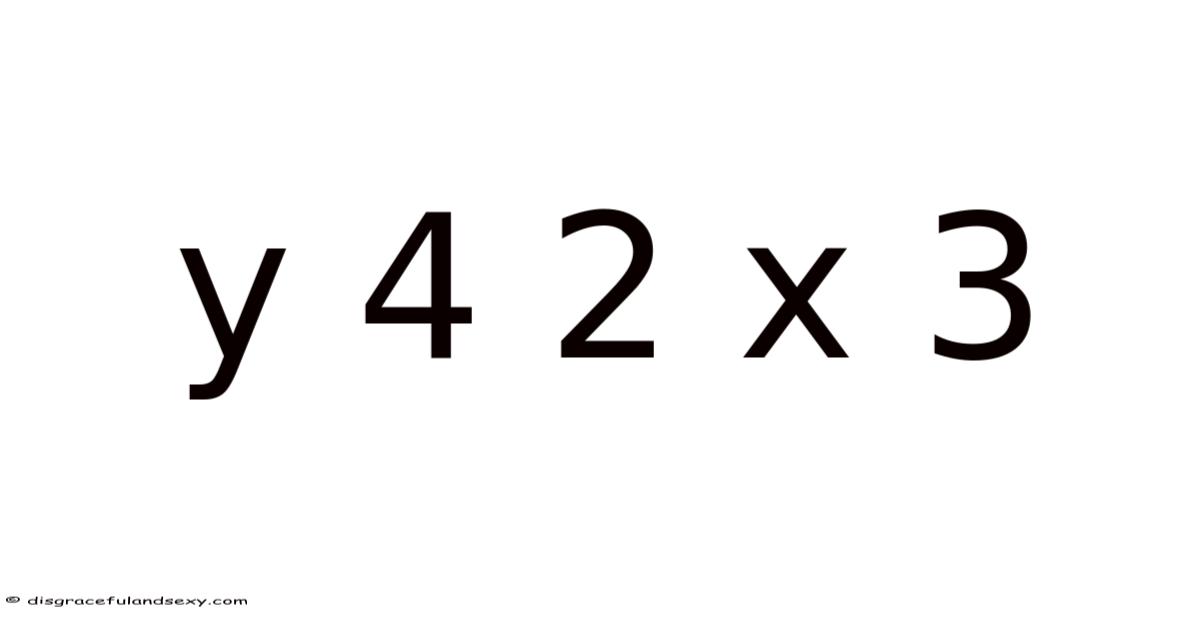
Decoding the Mathematical Expression: y = 4 / 2 x 3
This article breaks down the seemingly simple yet surprisingly complex mathematical expression, y = 4 / 2 x 3. Practically speaking, understanding how to solve this equation correctly highlights the crucial role of the order of operations, a fundamental concept in mathematics. This exploration will not only provide the solution but also clarify the underlying principles, common misconceptions, and the broader implications of correctly interpreting mathematical notation.
Introduction: The Importance of Order of Operations (PEMDAS/BODMAS)
At first glance, y = 4 / 2 x 3 might seem straightforward. Now, this is where the order of operations comes into play. Still, the absence of explicit parentheses introduces ambiguity. This set of rules dictates the sequence in which calculations should be performed to ensure a consistent and unambiguous result.
The official docs gloss over this. That's a mistake.
- PEMDAS: Parentheses, Exponents, Multiplication and Division (from left to right), Addition and Subtraction (from left to right).
- BODMAS: Brackets, Orders, Division and Multiplication (from left to right), Addition and Subtraction (from left to right).
Both acronyms represent the same order of operations; the differences in terminology are simply regional variations. Let's break down how these rules apply to our equation.
Step-by-Step Solution Using PEMDAS/BODMAS
Applying the order of operations to y = 4 / 2 x 3:
-
No Parentheses/Brackets: Our equation doesn't contain parentheses or brackets, so we move to the next step.
-
No Exponents/Orders: There are no exponents or orders (roots) in the equation.
-
Multiplication and Division (from left to right): This is where the crucial step lies. Many incorrectly prioritize multiplication over division. On the flip side, PEMDAS/BODMAS dictates that multiplication and division have equal precedence and should be performed from left to right.
Which means, we first calculate 4 / 2 = 2.
-
Multiplication (Continuing from left to right): Now, we take the result from the previous step (2) and multiply it by 3: 2 x 3 = 6.
-
Because of this, y = 6.
The Correct Answer and Common Misconceptions
The correct answer to y = 4 / 2 x 3 is 6. On the flip side, many individuals arrive at the incorrect answer of 1. This often stems from incorrectly prioritizing multiplication over division, performing 2 x 3 first and then dividing 4 by the result (6), leading to 4/6 = 0.666.. And that's really what it comes down to..
This highlights the vital importance of strictly adhering to the order of operations. Failing to do so can lead to significant errors, especially in more complex equations It's one of those things that adds up..
Illustrative Examples: Highlighting the Importance of Parentheses
To further clarify the impact of order of operations, let's consider some variations of our original equation using parentheses:
-
y = (4 / 2) x 3: The parentheses dictate that we perform the division first: (4 / 2) = 2. Then, we multiply by 3: 2 x 3 = 6. The result remains 6 Small thing, real impact..
-
y = 4 / (2 x 3): Here, the parentheses dictate that we perform the multiplication first: (2 x 3) = 6. Then, we perform the division: 4 / 6 = 0.666... Notice how the placement of parentheses drastically alters the result.
Beyond the Basics: Exploring More Complex Scenarios
The principles illustrated with y = 4 / 2 x 3 extend to far more complex mathematical expressions. Consider equations involving multiple operations, exponents, and nested parentheses. The consistent application of PEMDAS/BODMAS remains critical for accuracy.
For example: y = 5 + 2³ x (4 - 1) / 2
- Parentheses: (4 - 1) = 3
- Exponents: 2³ = 8
- Multiplication: 8 x 3 = 24
- Division: 24 / 2 = 12
- Addition: 5 + 12 = 17
So, y = 17.
The Scientific Perspective: Why Order of Operations Matters
The order of operations isn't merely an arbitrary convention; it's rooted in the fundamental structure of mathematics. Consider the following:
-
Consistency: Without a consistent order of operations, different interpretations of the same equation would yield different results, creating chaos and ambiguity in mathematical calculations.
-
Algebraic Manipulation: The order of operations is essential for performing algebraic manipulations correctly. Solving equations, simplifying expressions, and working with functions all rely heavily on the correct order of operations.
-
Programming and Computation: Computer programming languages and calculators use the order of operations to interpret mathematical expressions. Understanding this order is crucial for writing accurate and effective code.
-
Real-World Applications: From engineering calculations to financial modeling, accurate application of the order of operations is essential in numerous real-world scenarios. Errors in this fundamental concept can lead to catastrophic consequences.
Frequently Asked Questions (FAQ)
Q: Why is the order of operations important?
A: The order of operations ensures consistent and unambiguous results when evaluating mathematical expressions. Without it, different interpretations of the same equation could lead to vastly different answers.
Q: What happens if I don't follow the order of operations?
A: You'll likely obtain an incorrect answer. The result will be inconsistent with the accepted mathematical interpretation of the expression No workaround needed..
Q: Is there a universally accepted order of operations?
A: Yes, the order of operations (PEMDAS/BODMAS) is universally accepted within the mathematical community and is the foundation for evaluating mathematical expressions But it adds up..
Q: Are there any exceptions to the order of operations?
A: While the core principles remain consistent, the use of parentheses can override the standard order, forcing specific calculations to be performed first Practical, not theoretical..
Q: How can I improve my understanding of the order of operations?
A: Practice is key! Work through numerous examples, starting with simple expressions and gradually progressing to more complex ones. Use online resources and interactive tools to reinforce your understanding And that's really what it comes down to..
Conclusion: Mastering the Fundamentals
The seemingly simple equation y = 4 / 2 x 3 serves as a powerful illustration of the importance of understanding the order of operations. Mastering this fundamental concept is not only crucial for achieving accurate results in mathematics but also forms the bedrock for more advanced mathematical concepts and real-world applications. Consider this: remember, consistent practice and a thorough grasp of the rules are the keys to mastering the order of operations and achieving mathematical proficiency. So by strictly adhering to PEMDAS/BODMAS and understanding the underlying principles, you can confidently tackle a wide range of mathematical problems and avoid common pitfalls. The ability to correctly interpret and solve such equations is a cornerstone of mathematical literacy, essential for success in various fields of study and professional endeavors Not complicated — just consistent..
Honestly, this part trips people up more than it should.
