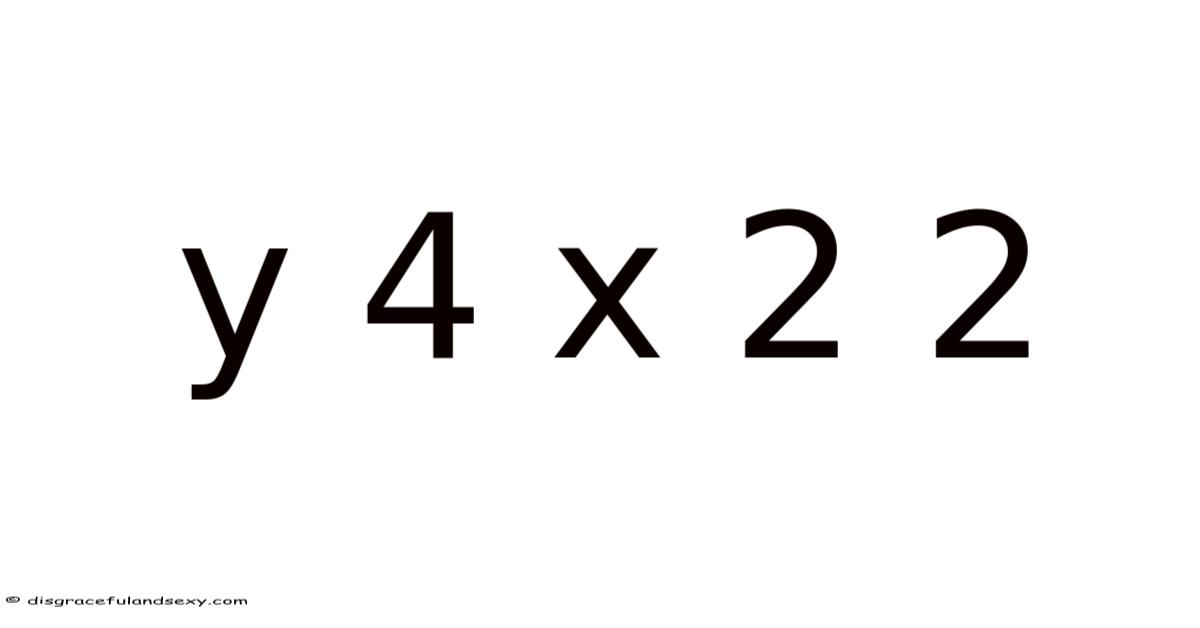
Decoding the Mathematical Expression: y = 4x² + 2x + 2
This article gets into the mathematical expression y = 4x² + 2x + 2, exploring its properties, graphical representation, and practical applications. Understanding this type of quadratic equation is fundamental to various fields, from physics and engineering to economics and computer science. We'll break down the equation step-by-step, making it accessible to anyone with a basic understanding of algebra. This full breakdown will equip you with the knowledge to not only solve this specific equation but also to tackle similar quadratic equations confidently.
Introduction to Quadratic Equations
Before we dive into the specifics of y = 4x² + 2x + 2, let's establish a foundational understanding of quadratic equations. A quadratic equation is a polynomial equation of the second degree, meaning the highest power of the variable (in this case, x) is 2. The general form of a quadratic equation is:
ax² + bx + c = 0
where 'a', 'b', and 'c' are constants, and 'a' is not equal to zero (otherwise, it wouldn't be a quadratic equation). Our equation, y = 4x² + 2x + 2, is a slightly different presentation; it's expressed in the form of a function, where 'y' represents the output value for a given input 'x'. Still, the underlying principles remain the same Most people skip this — try not to. Still holds up..
Identifying the Key Components
Let's break down the components of our equation, y = 4x² + 2x + 2:
-
4x²: This term represents the quadratic term. The coefficient '4' (the number multiplying x²) determines the parabola's vertical stretch or compression. A coefficient greater than 1 stretches the parabola vertically, making it narrower. A coefficient between 0 and 1 compresses it, making it wider. A negative coefficient reflects the parabola across the x-axis.
-
2x: This is the linear term. The coefficient '2' (the number multiplying x) affects the parabola's position and slope. It contributes to the parabola's horizontal shift and overall tilt Not complicated — just consistent..
-
2: This is the constant term. It represents the y-intercept—the point where the parabola intersects the y-axis (when x = 0). In our case, the parabola intersects the y-axis at the point (0, 2).
Graphing the Quadratic Equation
Understanding the graphical representation of a quadratic equation is crucial. The graph of a quadratic equation is always a parabola—a U-shaped curve. The parabola's shape, orientation, and position are determined by the coefficients 'a', 'b', and 'c'.
In our equation, y = 4x² + 2x + 2:
- a = 4: Since 'a' is positive, the parabola opens upwards (U-shaped).
- b = 2: This affects the parabola's vertex (the lowest point of the parabola).
- c = 2: This is the y-intercept; the parabola crosses the y-axis at (0, 2).
To accurately plot the graph, you can use various methods:
- Plotting points: Choose several values for 'x', substitute them into the equation, calculate the corresponding 'y' values, and plot these (x, y) coordinates on a graph. Connect the points to form the parabola.
- Finding the vertex: The x-coordinate of the vertex is given by the formula: x = -b / 2a. In our case, x = -2 / (2 * 4) = -1/4. Substitute this value back into the equation to find the y-coordinate of the vertex.
- Using graphing software or calculators: Many online tools and calculators can graph quadratic equations automatically. Simply input the equation, and the software will generate the graph.
The graph will reveal key features such as the vertex (minimum point), the axis of symmetry (a vertical line passing through the vertex), and the x-intercepts (points where the parabola intersects the x-axis, if any).
Finding the x-intercepts (Roots)
The x-intercepts, also known as roots or zeros, are the points where the parabola intersects the x-axis (where y = 0). To find the x-intercepts, we set y = 0 and solve the quadratic equation:
4x² + 2x + 2 = 0
This equation doesn't factor easily, so we'll use the quadratic formula:
x = [-b ± √(b² - 4ac)] / 2a
Substituting the values from our equation (a = 4, b = 2, c = 2):
x = [-2 ± √(2² - 4 * 4 * 2)] / (2 * 4) x = [-2 ± √(-28)] / 8
Notice that the discriminant (b² - 4ac = -28) is negative. Put another way, the quadratic equation has no real roots. The parabola does not intersect the x-axis. The roots are complex numbers involving the imaginary unit 'i' (√-1).
Understanding the Discriminant
The discriminant (b² - 4ac) has a big impact in determining the nature of the roots of a quadratic equation:
- If b² - 4ac > 0: The equation has two distinct real roots. The parabola intersects the x-axis at two points.
- If b² - 4ac = 0: The equation has one real root (a repeated root). The parabola touches the x-axis at one point (the vertex).
- If b² - 4ac < 0: The equation has no real roots. The parabola does not intersect the x-axis. The roots are complex conjugates. This is the case with our equation.
Completing the Square
Another method to solve quadratic equations is completing the square. This technique involves manipulating the equation to create a perfect square trinomial, which can then be easily factored. Let's apply this to our equation:
4x² + 2x + 2 = 0
-
Divide the equation by the coefficient of x² (4): x² + (1/2)x + (1/2) = 0
-
Move the constant term to the right side: x² + (1/2)x = -1/2
-
Take half of the coefficient of x ((1/2)/2 = 1/4), square it ((1/4)² = 1/16), and add it to both sides: x² + (1/2)x + (1/16) = -1/2 + (1/16)
-
Factor the left side as a perfect square: (x + 1/4)² = -7/16
-
Solve for x: x + 1/4 = ±√(-7/16) x = -1/4 ± (i√7)/4
Again, we obtain complex roots, confirming our earlier finding Not complicated — just consistent. Which is the point..
Applications of Quadratic Equations
Quadratic equations have numerous applications across various fields:
- Physics: Describing projectile motion (the path of a ball thrown in the air), calculating the trajectory of objects under the influence of gravity.
- Engineering: Designing parabolic antennas, bridges, and other structures.
- Economics: Modeling cost functions, revenue functions, and profit maximization.
- Computer Graphics: Creating curved shapes and animation.
- Data Analysis: Curve fitting and regression analysis.
Frequently Asked Questions (FAQ)
Q: What is the vertex of the parabola represented by y = 4x² + 2x + 2?
A: The x-coordinate of the vertex is -b/2a = -2/(2*4) = -1/4. Practically speaking, substituting this into the equation gives the y-coordinate: y = 4(-1/4)² + 2(-1/4) + 2 = 7/4. So, the vertex is (-1/4, 7/4).
Q: Why does the equation have no real roots?
A: Because the discriminant (b² - 4ac) is negative (-28). A negative discriminant indicates that the parabola does not intersect the x-axis, resulting in complex roots.
Q: Can I use a different method to solve this equation besides the quadratic formula and completing the square?
A: While the quadratic formula and completing the square are common methods, numerical methods like the Newton-Raphson method can also be used to approximate the roots (although in this case, they would yield complex roots).
Q: What is the significance of the coefficient 'a' in a quadratic equation?
A: The coefficient 'a' determines the parabola's vertical scaling and orientation. If 'a' is positive, the parabola opens upwards; if 'a' is negative, it opens downwards. The magnitude of 'a' affects the parabola's width (larger 'a' means narrower parabola).
Conclusion
The seemingly simple equation y = 4x² + 2x + 2 reveals a rich tapestry of mathematical concepts, from the properties of parabolas to the nature of roots and the power of different solution methods. In real terms, understanding quadratic equations is a cornerstone of mathematical literacy, paving the way for more advanced studies in algebra, calculus, and numerous applications in various fields. This comprehensive analysis aims to demystify this type of equation, empowering you to confidently tackle similar problems and appreciate the elegance and practicality of quadratic functions. Remember to practice regularly to solidify your understanding and build your problem-solving skills.
